Every piece here starts from a question we are asked repeatedly by foreign professionals moving to China — and most of them are answered badly elsewhere, usually by restating the regulation without saying what happens at the counter. So the format is consistent: state the rule, then describe the part that actually decides outcomes (timing, documents, local practice, what an employer will and will not do), then give you the next concrete step.
Each article is dated, because Chinese immigration and tax rules change and a stale guide is worse than none. Where practice varies by city, we say so rather than inventing a national average. Nothing here is legal advice, and we would rather tell you we do not know than fill the gap.
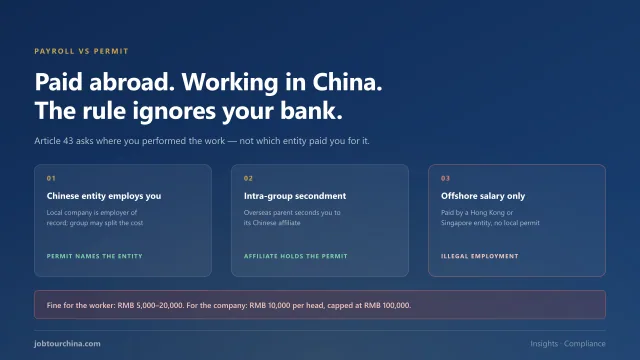
Paid from Abroad, Working in China
Your salary lands offshore, you sit in Shenzhen, and everyone assumes the paperwork is settled. Why Article 43 looks at where you worked, not who paid you.
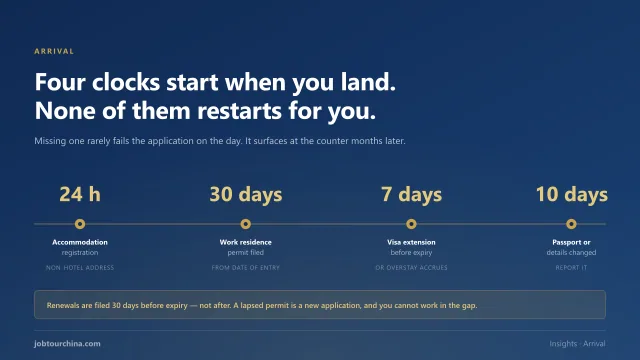
Your First 30 Days
Four clocks start at different moments after you land: 24 hours, 30 days, 7 days, 10 days. The deadline table — and what missing one actually costs.
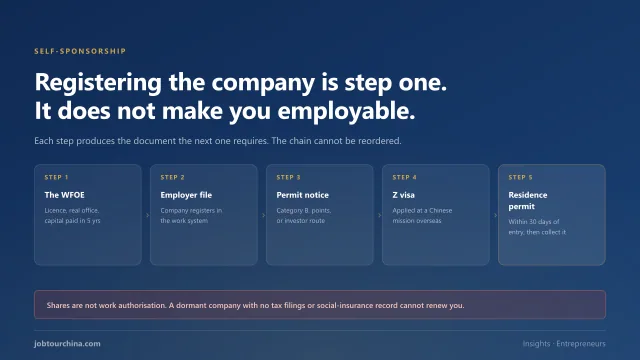
Can You Sponsor Your Own Work Visa?
Owning a Chinese company is not work authorisation. The five-step sequence from business licence to residence permit, and why shell entities fail at renewal.
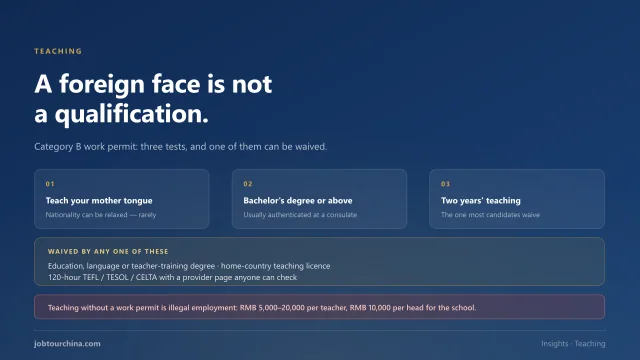
Teaching English in China
A native passport is not a teaching licence. The Category B test — degree, two years' experience, and the waiver document that replaces it — plus what the school has to file.
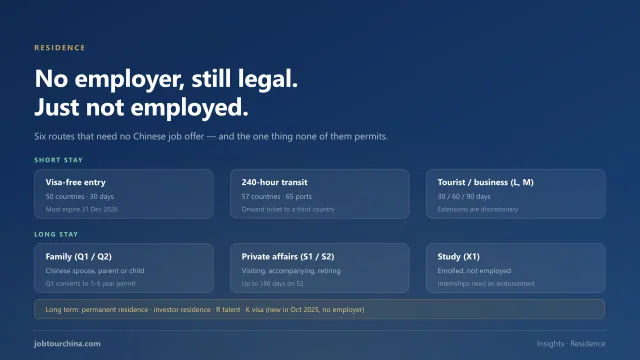
Staying in China Without an Employer
Visa-free entry, family, study, the new K visa — six routes that need no job offer, and the one thing none of them lets you do.
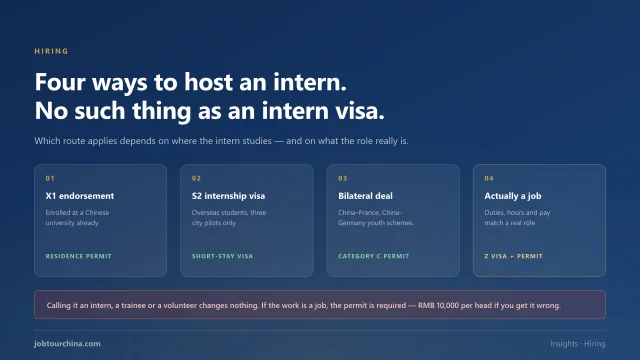
Hiring Foreign Interns
No national intern visa means four different filings depending on where the intern studies. The employer-side map, and what the wrong route costs.
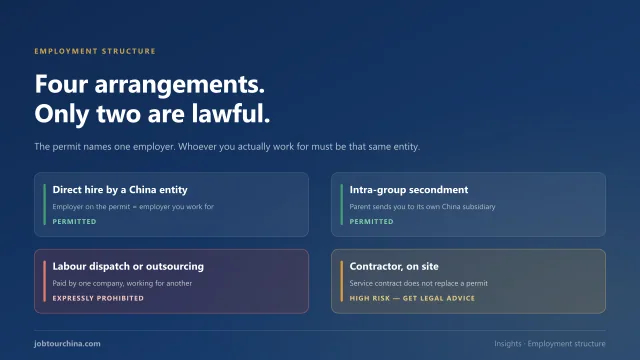
Outsourcing, dispatch and contracting
Can a foreign professional work in China through an outsourcing or dispatch arrangement? Usually not — here is the rule, the compliant alternatives, and the red flags to watch for in an offer.
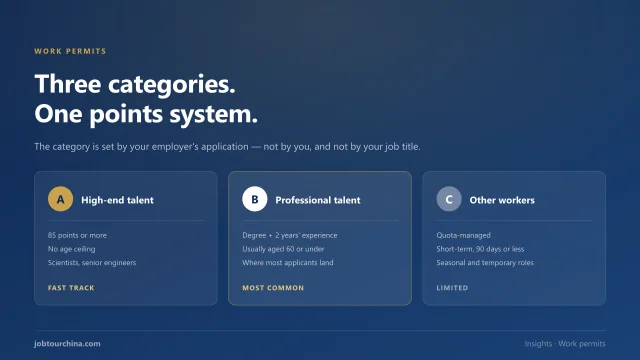
Work permit categories A, B and C
China sorts foreign workers into three categories that decide permit length, age limits and dependants. What each category means, and what moves you up a tier.
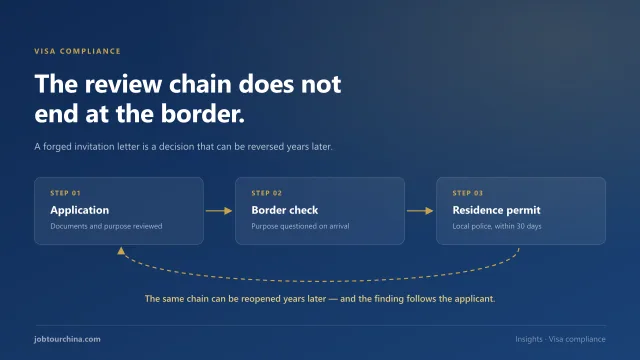
Fake Invitation Letters
China treats visa fraud as retroactive: a forged invitation letter can void your visa years later and block future permits. What the Shanghai case shows, and the red flags to spot.
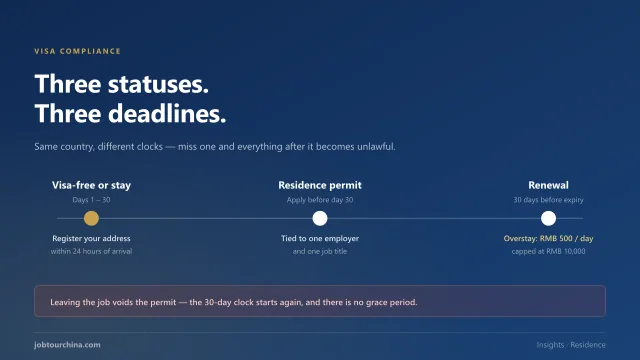
Stay vs Residence in China
Stay, residence permit, visa-free entry — three legal statuses with different deadlines. How long you can stay, when to extend, and what an overstay actually costs.
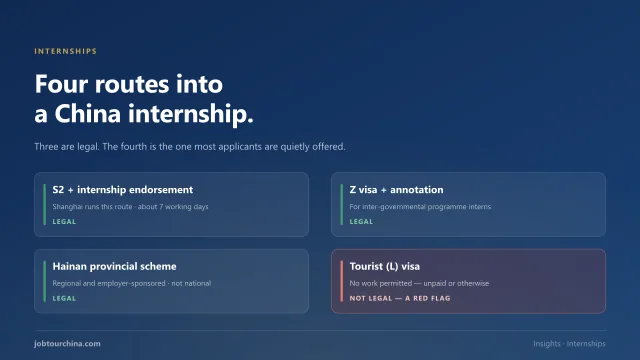
Internships in China for Foreign Students
China has no national internship visa. Shanghai endorses S2 visas for interns, Hainan runs its own scheme, and 'just come on a tourist visa' is a trap.
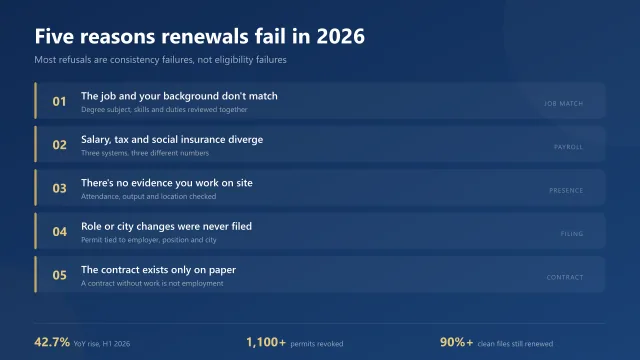
Work Permit Renewals in 2026
China stopped treating renewal as a paperwork check. Five consistency failures now sink otherwise eligible files.
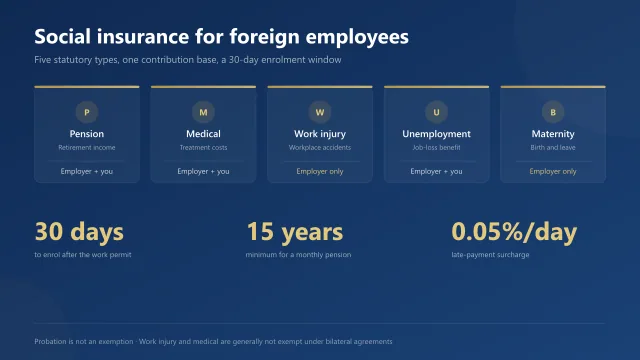
Social Insurance for Foreign Employees
Nine questions that decide whether your contributions, pension and permit records all agree with each other.
How to Reach a Chinese Employer: Email, WeChat, Job Boards
Most China job ads never list an email. Here is how hiring actually works: which channel to use, the subject line they expect, and why emails get ignored.
Job searchPracticalWhat Foreigners Can Actually Be Hired For in China
Three quarters of the roles open to foreigners in China are teaching. Here is what the rest require, and why a Chinese licence blocks most of it.
LicensingJob searchChina Work Permit Documents, in the Right Order
Degree, police check, medical, contract: each has a validity window, and the police certificate expires fastest. Here is the order that avoids doing them twice.
Work permitsPracticalThe China Work Visa Sequence: Two Clocks, Not One
The employer files, you collect a Z visa, then two clocks start on the day you land: 15 days for the work permit card, 30 for the residence permit.
Work permitsProcessWhat You Should Never Pay For in China
Placement fees, guaranteed-visa packages, deposits before a contract: none are normal. What the law says, and how to check an employer in minutes.
Job searchPracticalHow to Get Hired in China: The Five Steps
A five-part guide in the order the decisions actually happen: what you can be hired for, the documents, reaching a human, the visa, and what never to pay.
Job searchGuideCan Tourism or Hospitality Get You a China Work Visa?
Hotels, travel agencies and resorts hire locally. Here is where the three real openings are, and what each one actually requires.
IndustriesWork permitsFlying in China on a Foreign Licence: What the CAAC Requires
The CAAC recognises foreign pilot licences, but only on nine published conditions. Here is the list, and what it means for an airline job in China.
IndustriesLicensingWorking on a China-Based Cruise Ship: Who Hires Foreign Crew
China's cruise fleet is expanding and most of its crew is foreign. Here is how the hiring actually works, and what it does not give you.
IndustriesHiringNGO Jobs in China: The Four Posts the Law Actually Names
A foreigner can work for an overseas NGO in China, but only through a registered representative office, and the law names four posts.
IndustriesLegalExhibitions in China: Bilingual Work, Not Foreign Work
The exhibition industry runs in English and Mandarin at the same time. That is the gate, and it decides which roles a foreign applicant can actually get.
IndustriesLanguagesCoaching in China: The Visa a Coach Actually Needs
A sports M visa covers a trial stint, not a coaching season — and competition work is excluded outright. Here is the permit that works, and who hires.
IndustriesWork permitsHotel Groups in China: The Door Is a Transfer, Not a Vacancy
China's hotel leadership pipeline is filled from inside, and the graduate programme is restricted to Chinese nationals. Here is how foreigners actually get in.
IndustriesCareersTreating Patients in China: The Licence Nobody Mentions
A separate registration lets a foreign doctor treat patients for up to a year without a Chinese medical licence. Here is how it works, and what it does not cover.
IndustriesLicensingSelling Abroad from China: The Sector Cities Recruit For
Export livestreaming is the one field where city governments recommend foreigners for work permits. Here is the mechanism, and the catches.
IndustriesHiringDesigning in China: Why the Stamp Is Not Yours
Foreign architects work on China's biggest projects, but the statutory signature belongs to a registered Chinese architect. What that means for your role and your permit.
IndustriesLicensingChambers of Commerce: A Channel, Not a Visa
AmCham-style chambers hire bilingual staff and publish member job boards, but their internships exclude foreign professionals. Here is what they actually offer.
IndustriesHiringYour Documents Depend on Your Country, Not on Your CV
Apostille, consular legalisation or nothing at all: which Chinese work-permit documents change with where you obtained them, and which do not.
DocumentsWork permits