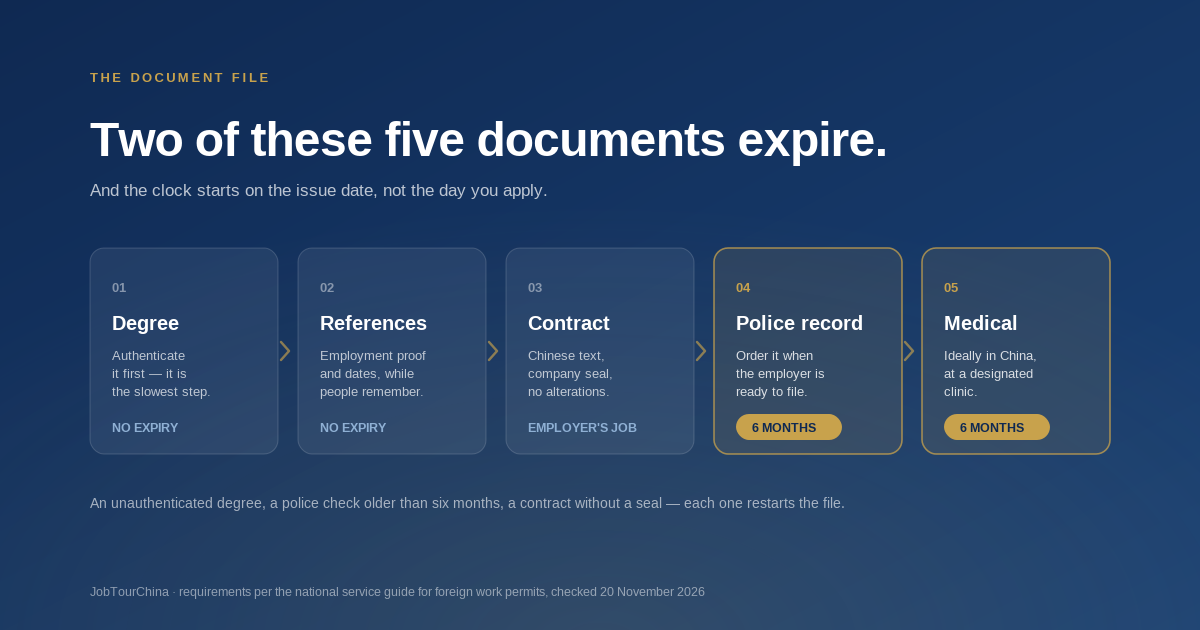
The document set for a Chinese work permit is short: five items. What defeats people is not the number. It is that two of them expire, one is slow to authenticate, and the order most people collect them in is the order that forces them to start again.
This page sets out what each document has to be, which ones carry a clock, and the sequence that avoids doing any of it twice.
The five documents, and what makes each one valid
| Document | Who issues it | What makes it valid | What voids it |
|---|---|---|---|
| Degree certificate | Your university | Authenticated by a Chinese embassy or consulate, by your country's embassy in China, or by a Chinese academic credential body | An unauthenticated copy, however official it looks |
| Police / criminal record | Police, security or court in your country of nationality or habitual residence | Issued within the last 6 months, then authenticated | A sworn statement you write yourself; anything older than 6 months |
| Medical certificate | A Chinese inspection and quarantine body, or a clinic it recognises abroad | Issued within the last 6 months | A clinic that is not on the recognised list |
| Employment contract | Your employer | Chinese-language text, signed, company seal, no alterations; names location, duties, salary, dates and position | English-only text; no signature; any correction on the page |
| Work experience proof | Previous employers | Non-Chinese text accompanied by a translation carrying a company seal | A reference letter with no dates or job title |
Two rows in that table carry a deadline, and the deadline does not start when you decide to apply. It starts on the date printed on the certificate.
The six-month clock
The official service guide is explicit on both points. The police record must have been issued within 6 months. The medical certificate must likewise have been issued within 6 months. Neither window is measured from the day you post it, and neither can be extended.
This is the single most common way an application stalls. Someone orders a police check in the spring, spends two months chasing a degree authentication and a contract revision, and files in the autumn with a certificate that is already dead. The fix is sequencing, not speed.
Authentication changed in November 2023
Until recently, a foreign document used in China went through two steps: notarisation at home, then legalisation at the Chinese embassy. That is no longer true for most countries. China acceded to the Hague Apostille Convention, and it entered into force for China on 7 November 2023. For documents issued in another member state, a single apostille replaces the whole consular chain.
As of late 2026 the Convention has 130 contracting parties, including the United States, the United Kingdom, Canada, Australia, Japan, South Korea, India, Indonesia, Singapore and every EU member state. Vietnam has been covered since 11 September 2026.
Two cautions. First, accession is not the same as entry into force: Thailand has acceded, but the Convention only takes effect for it on 28 February 2027, so Thai documents still need consular legalisation today. Second, a handful of countries are outside the Convention entirely and keep the old route. Check your own country on the depositary's status table before you pay a notary for a service you may not need.
The order that works
- 1. Degree, first. It never expires, and authentication is the slowest step in the whole file. Start it before you have a job offer if you are serious about China.
- 2. References and employment proof. Also no expiry. Ask previous employers now, while they still remember you.
- 3. The contract, in Chinese. This is the employer's job, but check it: Chinese text, company seal, and the five content items present. An English-only contract is not the document the permit file needs.
- 4. Police certificate. Order it when the employer says they are ready to file — not before. It is the document most likely to expire while you wait for someone else.
- 5. Medical. Ideally after arrival in China, at a designated inspection and quarantine clinic. See the trap below.
The medical certificate trap
A medical done abroad can be accepted at the pre-entry stage, and some routes allow an undertaking instead of the certificate at that point. But the permit itself, issued after you arrive, requires a Chinese certificate — either the record verification issued by a Chinese inspection and quarantine body, or a health certificate from one.
So an overseas medical is often money spent twice. It may be needed for the visa application, and it will still be replaced after entry. Ask the employer which stage they need it for before booking anything.
Category A skips the two slowest documents
If you qualify as high-end talent (Category A), the degree certificate and the police record can both be handled by a written undertaking instead of the authenticated original. That is a substantial difference: it removes precisely the two items that take longest and expire fastest.
Whether you qualify is decided by the points table, not by your employer's opinion. The three categories and what moves you between them covers that in detail.
The clock that is not yours
Once a complete file is submitted, the Chinese side is comparatively quick: Shanghai's bundled service commits to 11 working days for the permit package. Almost every delay before that point belongs to the applicant or the employer — a missing seal, a reference letter without dates, a certificate that expired in the post.
Which is why the useful question is not “how long does China take?” but “which document in my file has the earliest expiry date, and is the employer ready before it?”
Before you pay anyone
- An apostille is issued by a government authority, not a translation agency. If someone offers to “arrange the apostille” for a fee, ask which authority issues it in your country.
- A photocopy cannot be apostilled as if it were the original. Most authorities require the original or a certified copy first.
- Translations need a seal. A plain translation file is not what the file requires.
- Nobody can guarantee a permit. The decision is made by the permitting authority on the documents, and the documents either meet the standard or they do not.
Where these rules come from
The requirements above are taken from the national service guide for foreign work permits and from the depositary's own status table, not from agency websites:
- National Foreign Experts Affairs service guide — the material list, the 6-month rules and the Category A undertaking
- Shanghai foreign work “one thing” service — committed processing time
- HCCH Apostille status table — whether your country is covered, and from which date
Two related pages are worth reading next: what happens in your first week after arrival, and which jobs are actually open to foreign nationals in the first place.
This page is provided for general information only, not as legal or immigration advice, and does not guarantee any application outcome. Requirements are set by the permitting authority in the city where you apply and can change; confirm with your employer before filing.