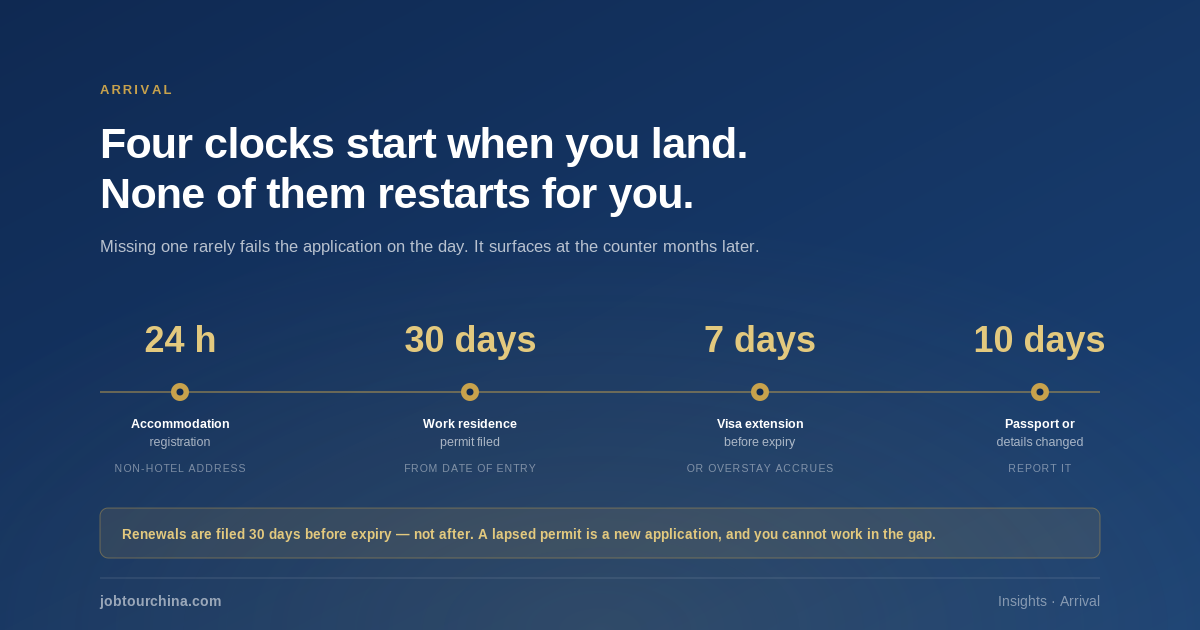
Four deadlines matter in your first month, and they start at different moments. Accommodation registration is due within 24 hours of moving into a non-hotel address. The work-type residence permit must be filed within 30 days of entry. A visa extension needs to go in 7 days before expiry. Any change to your passport or personal details has to be reported within 10 days. Everything else — the SIM card, the bank account, the tax number — is convenience, not compliance.
Most of what follows is drawn from the 2026 edition of the Ministry of Commerce guide for business expatriates, cross-checked against the National Immigration Administration. Where the official guidance and current practice diverge, we say so.
The deadline table
| Task | Deadline | Consequence of missing it |
|---|---|---|
| Accommodation registration (non-hotel) | 24 hours after arrival | Adverse entry-exit record; read at your next visa or permit application |
| Work-type residence permit | 30 days after entry | Unlawful stay once the Z visa's entry validity lapses |
| Visa extension | 7 days before expiry | Overstay; fines accrue per day of overstay |
| Change of passport or personal data | 10 days after the change | Permit no longer matches your identity documents |
| Residence permit extension | 30 days before expiry | Gap in lawful residence; renewal treated as a new application |
| Work permit extension (filed by employer) | 30 days before expiry | Permit lapses; you cannot legally work while it is being re-filed |
| Work permit changes (name, passport, position) | 10 working days, filed by employer | Working outside the permit's recorded scope |
Accommodation registration: the 24-hour rule
Stay in a hotel and the front desk does it for you — that is the one part of this system that works without your involvement. Stay anywhere else, including a serviced apartment, a friend's flat or a lease you signed yourself, and the registration is your responsibility within 24 hours of arrival.
Mechanically it is simple: you or your host takes your passport to the local police station serving that address. Seven provinces and municipalities — Hebei, Liaoning, Zhejiang, Hubei, Guangxi, Chongqing and Sichuan — now allow the registration to be completed online, which removes most of the friction. Outside those, assume you are going to a police station in person.
What people get wrong is the address. The registration is tied to a specific address, so moving apartments mid-stay means re-registering. The record also has to match the address on your residence permit application later; a mismatch is one of the most common reasons a permit file gets sent back for correction rather than approved.
The numbers worth saving in your phone
110 police, 119 fire, 120 ambulance. For anything immigration-related — visa status, permit progress, whether a document needs legalisation — 12367 is the National Immigration Administration line, staffed 24 hours in Chinese and English. From outside China, dial +86 12367.
If your passport goes missing, report it at the nearest police station before doing anything else, and keep the report. That document is what lets you replace the passport and, later, re-establish your permit. Replacing the passport without the police report is the slow route.
The things that are not compliance but will ruin your week
A SIM card needs your passport and a visit to a China Mobile, Unicom or Telecom branch; some carriers now issue eSIMs. A bank account can be opened at most commercial banks on a passport, though branches vary in what else they ask for. WeChat Pay, Alipay and UnionPay accept overseas Visa, Mastercard and American Express cards, and a number of foreign wallets now work for domestic QR payments.
Train tickets can be bought on the 12306 English site and app with passport-based real-name verification. Metro systems in Beijing, Shanghai, Guangzhou and Shenzhen accept tap-and-go with overseas bank cards at the gates. Ride-hailing runs through DiDi or the transport module inside Alipay. If you buy goods at designated tax-refund shops, the VAT refund is claimed at the departure port against a minimum spend per receipt.
None of this is legally required. All of it is what people actually struggle with in week one, and sorting it early frees the time you need for the permit file.
The 183-day line
Tax residency in China turns on days present, not on your contract. Spend 183 days or more in a calendar year and you are a Chinese tax resident, filing on worldwide income; below that you are a non-resident taxed only on China-sourced income. Residents complete the annual comprehensive-income reconciliation between March and June of the following year.
If you hold a valid work permit and residence permit, you participate in the five categories of social insurance. Nationals of countries with bilateral social-security agreements may be exempt from some categories under the treaty — worth checking before you assume the deduction is unavoidable, and worth checking before you assume it is avoidable.
Entry status is not work status
Three facilitation schemes get confused with permission to work, and none of them is. China has unilateral 30-day visa-free entry for ordinary-passport holders of 50 countries (business, tourism and family visits), full mutual exemption with 29 countries, and 240-hour visa-free transit for 57 countries through 65 ports across 24 provinces, covering up to ten days in a designated region for onward travellers only.
The transit scheme explicitly excludes work, study and news reporting. The 30-day scheme is for visits, not employment. Taking paid work — including part-time, remote-for-a-local-client, or live-streaming for a Chinese platform — on any of them is illegal employment, whatever the arrangement is called. If the plan is to work, the route is a Z visa and a work permit, and both are filed by the Chinese employer before you travel.
Five mistakes that cost the most
- Treating registration as a hotel problem. It is only a hotel problem while you are in a hotel.
- Waiting for the permit to "come through". The 30-day clock runs from entry, not from when your employer starts filing.
- Filing documents that were never legalised. Overseas degrees and police-clearance certificates need an apostille (for Hague Convention members) or consular legalisation (for everyone else), plus a Chinese translation. Unauthenticated documents are rejected outright.
- Assuming a business visa covers a paid project. An M or F visa is for commercial visits. It is not a short-term work permit.
- Letting a permit expire while negotiating a renewal. Extensions are filed before expiry, not after. A lapsed permit is a new application, and you cannot work in the gap.
What to do next
Put the four dates in your calendar the day you land: registration within 24 hours, residence permit by day 30, and both renewals set 45 days before expiry so there is room to file at the statutory 30. Then verify your document chain — degree, police clearance, translations, authentications — before your employer files, because that is where most delays actually originate.
This article is general guidance based on the rules in force at the date above, not legal or immigration advice. Requirements and local practice change; confirm your own case with the competent authority or a qualified professional.
Related reading: Stay vs residence permit · Work permit categories · Fake invitation letters · Work visa overview · All insights.
Sources
- Exit and Entry Administration Law of the People's Republic of China — National Immigration Administration, official English text. Articles 30, 32 and 39: 30-day residence permit application, 30-day extension window, 24-hour accommodation registration.
Official text, checked 18 November 2026. Quoted for reference only; the Chinese original prevails.