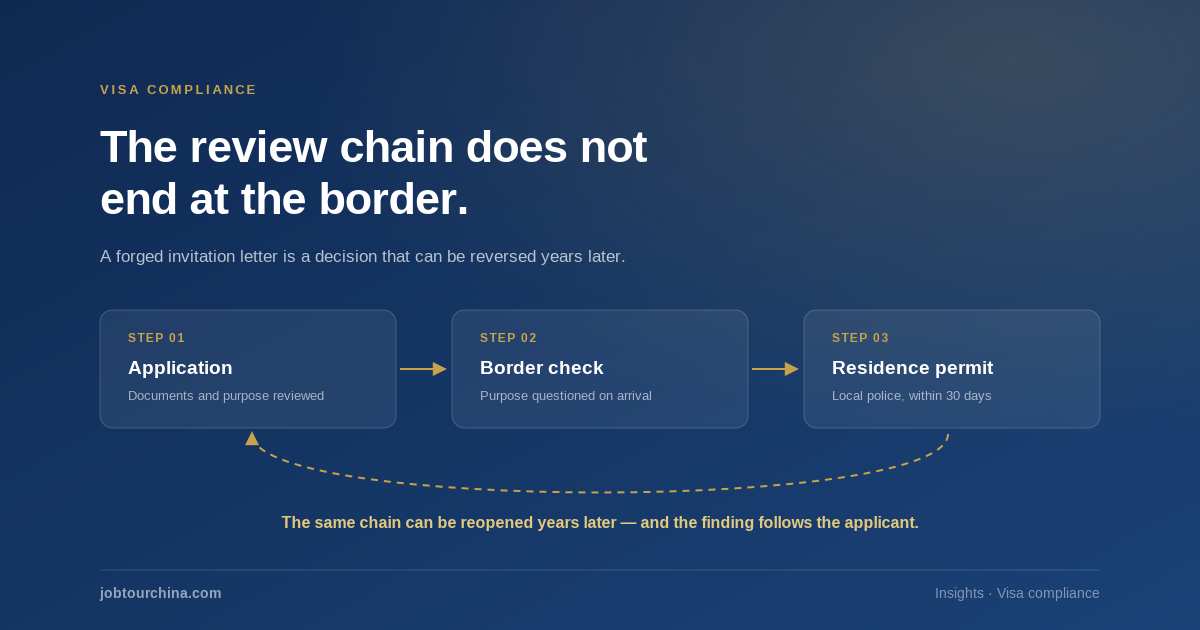
The most expensive misunderstanding in Chinese visa practice is that the sticker is the finish line. It is not. A Chinese visa is a pre-entry permission — the review chain runs through the application, the border check on arrival, and the residence registration that follows, and it can be reopened long after you have settled in.
That is why a forged invitation letter is not a paperwork shortcut. It is a decision that can be reversed years later, and the reversal usually lands on the applicant, not on the agency that sold it.
What happened in Shanghai
Shanghai police announced the break-up of an organised visa-fraud operation in early November 2026. According to the case report, the group ran a division of labour: forging complete document sets — business invitation letters, reception certificates, cooperation agreements — inventing purposes such as business talks and technical exchange, and submitting applications in batches for a fee. (Source: CN-WORK-GUIDE, 2 November 2026.)
The detail worth noticing is not the forgery. It is the industrialisation: standardised fake backgrounds, matched itineraries, prepared interview scripts, all designed to survive a first-pass document screen.
Why organised fraud is treated differently
A single applicant submitting one false document is handled as an administrative matter. A group that forges documents at scale for profit is handled under criminal law. The dividing line is organisation and commercial intent, not the number of pages in the file.
| Conduct | Legal track | Typical consequence |
|---|---|---|
| One applicant submits a false document | Exit and Entry Administration Law | Visa refused or revoked; fines; ordered to leave |
| Organising, forging at scale, charging a fee | Criminal Law — fraudulently obtaining exit-entry documents | Criminal liability, with substantially heavier sentencing exposure |
| Company lends its seal or issues a false invitation | Administrative, and potentially criminal as a participant | Investigation of the company as the inviting entity; penalties and reputational damage |
The legal characterisation in any individual case is for the authorities and a lawyer to determine. This table describes the general structure, not a prediction about any specific person.
Paper is no longer the check
Visa and immigration officers no longer rely on how convincing a document looks. Cross-verification is routine: calling the inviting company to confirm the relationship, the visitor and the reception arrangement, and checking whether the company actually operates. A forged set survives a visual inspection; it rarely survives a phone call to a receptionist who has never heard of you.
This is the part agencies do not explain. The reason a fabricated file "works" is that it has not been examined yet — not that it passed.
What a record actually costs
If a later review finds the invitation or the cooperation background false, the visa can be revoked even after entry, and the person is entered into the immigration adverse record. That record is not a short-lived flag. It travels with you into:
- future short-term visas — including business and tourist applications;
- work-permit applications, where the employer's sponsorship is assessed alongside your history;
- talent and high-level visa routes;
- permanent residence — the Five-Star Card.
For a professional whose career plan involves China, that is a far larger loss than the fee saved.
The product being sold to job seekers
The commercial version of this fraud reaches candidates through a familiar pitch: "we can arrange the invitation letter", "guaranteed approval", "we have internal channels", "just pay and we handle the visa". Sometimes it is dressed as a job offer with no interview, from a company whose name you cannot find anywhere.
Two things are usually true of these offers. The agency does not warn you about the criminal exposure, because the exposure is not theirs. And when a case is opened, the agency is the first party to become unreachable — leaving the applicant and the inviting company holding the consequences.
Red flags in an offer
- You never spoke to the employer. No interview, no named hiring manager, no verifiable company address.
- The invitation is the product. You are asked to pay for the letter itself, rather than for a service around a real job.
- The stated purpose does not match the work. A business visa (M) arranged for what is actually a paid role is not a work permit, and treating it as one is illegal employment.
- The company cannot be found. No record in the national enterprise credit system, no website, no staff you can reach independently.
- Urgency plus secrecy. "Submit this week, don't ask the company directly."
- Guaranteed outcomes. No legitimate party can guarantee a visa decision.
What a legitimate invitation looks like
In a real hiring process the invitation comes from the employer's own HR or government-affairs team, it names the role and the dates, and it is issued because the company wants you — not because a third party paid for it. You should be able to independently confirm the entity exists and operates, and to speak to the person who will manage you.
If the role is genuine employment, the correct route is a work permit plus a work-type residence permit, not a business or tourist visa. Our guide to work permit categories explains how that is assessed, and the work visa overview covers the sequence.
If you have already been offered this
- Do not submit anything until you have independently verified the inviting entity.
- Ask the employer directly, in writing, who issued the invitation and why.
- Walk away from any arrangement where the invitation is sold as a standalone product.
- If you have already submitted false material, get advice from a Chinese immigration lawyer before the review finds it — the position is materially different before versus after a finding.
This article is general guidance based on the rules in force at the date above, not legal or immigration advice. It summarises a case reported by a third-party publication and the statutory framework; it does not assert findings about any individual. Confirm your own situation with the competent authority or a qualified professional.
Related reading: Stay vs residence: staying legal · Outsourcing and dispatch · Work visa overview · All insights.
Sources
- Exit and Entry Administration Law of the People's Republic of China — National Immigration Administration, official English text. Article 21: grounds on which a visa shall not be issued, including fraudulent applications.
Official text, checked 18 November 2026. Quoted for reference only; the Chinese original prevails.