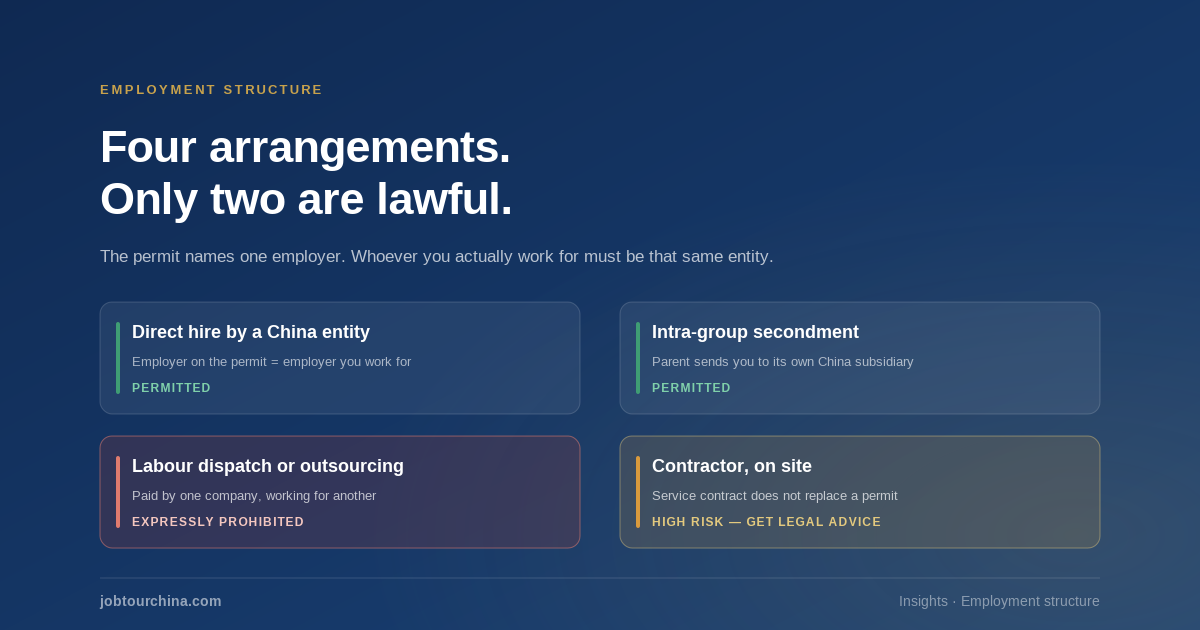
"Can I just be employed by an overseas company and be placed at a Chinese company?" It is one of the most common questions we get — and the answer is more restrictive than most people expect. China's immigration rules tie a foreigner's right to work to a specific employer, and the law expressly rules out the labour-dispatch and business-outsourcing models that are routine for Chinese nationals.
The short answer
In general, no. A foreign employee's work permit must name the unit they actually work for. Arrangements where a foreigner is employed by one company (an outsourcing firm, a staffing agency, or an overseas parent) but works day-to-day for another company in China are treated as unlawful. The permitted paths are narrower: direct employment by a Chinese entity, or an intra-group secondment where the Chinese entity is the sponsor.
The rule that decides everything
Under China's Exit and Entry Administration Law, a foreigner working in China must hold a work permit and a work-type residence permit, and no unit may employ a foreigner who lacks them. The implementing rules add the decisive detail: the employer must match the unit named on the work permit. The law then defines illegal employment to include working without the required permits and working outside the scope permitted.
Because the permit is tied to a named employer and an approved position, a structure that inserts a third party between the permit-holder and the place of work collides with the rule. That is why labour dispatch and business outsourcing — both lawful and common for Chinese citizens — are not available for foreign staff.
Four arrangements, four different answers
| Arrangement | Permitted? | What it requires |
|---|---|---|
| Employed directly by the Chinese company you work for | Yes | The Chinese entity is the sponsor and is named on the permit. |
| Overseas parent seconds you to its Chinese subsidiary | Yes, if structured correctly | The Chinese subsidiary is the employer of record and applies; the group provides a dispatch letter. |
| Staffing agency employs you and places you at a client | No | This is labour dispatch, which is not available for foreign employees. |
| You invoice a Chinese company as an independent contractor while living in China | High risk | If you are physically working in China, the permit-employer match is still expected; a services contract does not cure it. |
What "illegal employment" actually triggers
The consequences are not theoretical. A foreigner found working without the correct permit can be fined, and in serious cases detained and deported. The employer faces a separate penalty for each illegally employed foreigner, and anyone who introduces a foreigner to illegal work can be penalised too. Beyond fines, an immigration record of illegal employment can complicate future visa applications — which is why "it's only for a few months" is a bad trade.
The compliant routes, in practice
1. Direct employment by the Chinese entity
This is the cleanest route. The Chinese company signs the labour contract, sponsors the work permit, and is named on it. If you later change employers, the permit and residence permit must be changed with the help of both the old and new employer — you cannot simply start at the new company while the paperwork catches up.
2. Intra-group secondment
Multinationals routinely move staff into China this way. The overseas parent or regional headquarters issues a dispatch letter covering the role, location, duties, salary and duration, and the Chinese subsidiary (or branch) acts as the employing unit and applies for the permit. The key point is that a Chinese legal entity is in the chain — a foreign company with no Chinese presence cannot sponsor the permit on its own.
3. Short-term and project-based work
For work of 90 days or less, there is a lighter procedure aimed at specific projects and service contracts, and certain treaty-based "overseas contract service providers" can use an assignment letter rather than a full employment contract. This is genuinely useful for installation, commissioning, auditing or a defined consulting engagement — but it is time-limited and purpose-limited, not a way to run an open-ended role.
4. Employer-of-record arrangements — handle with care
Some providers offer to "employ" a foreigner in China and place them with a client. If the provider is the legal employer and is named on the permit, the structure can look compliant on paper; in substance, though, it can resemble the dispatch model the rules restrict. Treat this as a structure that needs a China employment lawyer's sign-off for your specific facts, not something to accept on a sales brochure.
Red flags in an offer
- "You'll be on our overseas payroll but work at our Shanghai office" — ask which Chinese entity sponsors the permit.
- "We'll sort out the visa after you start" — you cannot lawfully start first.
- "It's a contractor role, so no work permit needed" — if you are in China doing the work, that reasoning is unsafe.
- "You'll be dispatched to our client site" — clarify who the legal employer is and whether the permit names them.
- Payment split across jurisdictions with no Chinese contract — a compliance and tax problem, not a clever workaround.
A practical checklist
- Identify the exact Chinese legal entity that will employ you.
- Confirm that entity will sponsor your work permit and be named on it.
- Check that the approved position and location match what you will actually do.
- If you are being seconded, get the dispatch letter and confirm the Chinese entity applies.
- If you change employer, complete the permit change before starting.
- If the structure involves a third party, get written confirmation of who the employer of record is — and take advice.
This article is general guidance based on the rules in force at the date above, not legal advice. Enforcement and practice vary by city, and individual facts matter. Confirm your arrangement with the local work-permit authority or a qualified China employment lawyer before you sign.
Related reading: Work permit categories A, B and C · Work visa overview · Job board.
Sources
- Exit and Entry Administration Law of the People's Republic of China — National Immigration Administration, official English text. Articles 41 and 43: who must hold the permit, and working outside its scope.
Official text, checked 18 November 2026. Quoted for reference only; the Chinese original prevails.