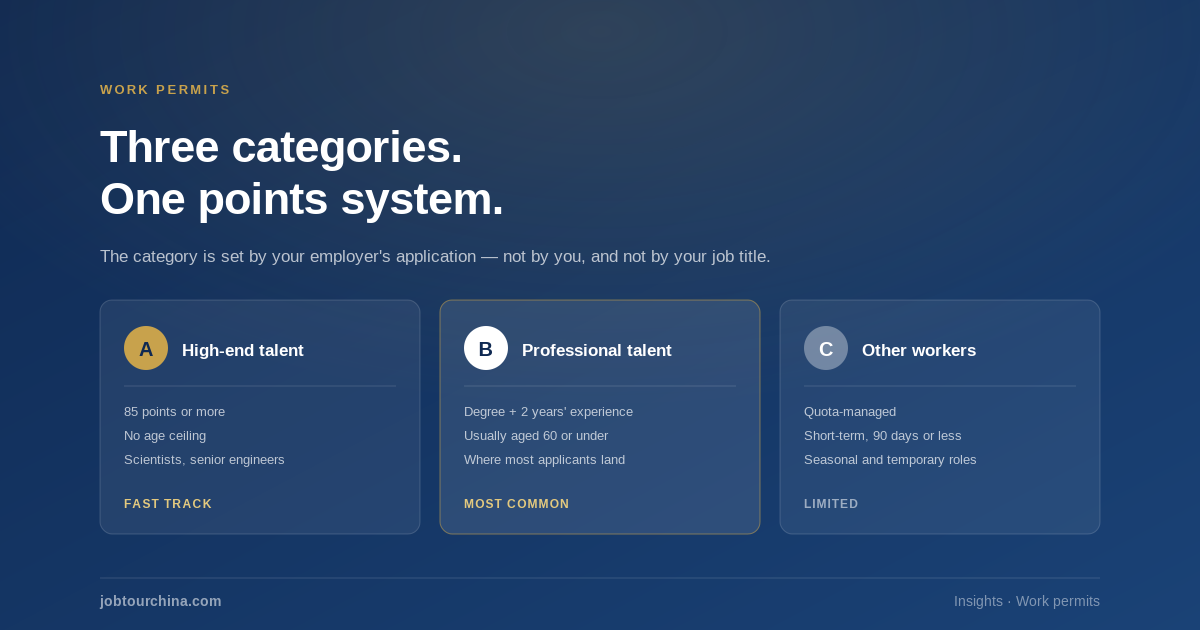
Most guides explain the Z visa and then stop. But the document that really determines your life in China — how long you can stay, whether you can bring your family, which employers will consider you — is the work permit, and work permits are sorted into three categories: A, B and C.
Understanding the categories before you apply changes which jobs are realistic, which cities are worth targeting, and what you should negotiate.
Why the category matters
China's work-permit system classifies foreign workers by value to the labour market. The category affects:
- the maximum validity of the permit;
- whether age and degree requirements apply;
- whether the role is subject to a quota;
- whether dependants can come with you;
- and, indirectly, how easily you can renew or change employers.
The three categories at a glance
| Category | Who it is for | Typical permit length | Key features |
|---|---|---|---|
| A — high-end talent | Scientists, senior technologists, international entrepreneurs and other "urgently needed" specialists | Up to 5 years | No age, degree or work-experience floor; no quota |
| B — professional talent | Foreign professionals with a degree and relevant experience | Typically up to 2 years | Bachelor's or above plus work experience; age limits generally apply |
| C — other | Temporary, short-term, quota-managed and student/graduate categories | Short, tied to contract or quota | Limited; not a route to long-term settlement |
Category A — high-end talent
Category A is the fast lane. It is aimed at people China actively wants: leading scientists, senior engineers in strategic fields, entrepreneurs, and specialists in short supply. The most striking feature is what it removes — A-category applicants are generally not subject to the usual age, degree and years-of-experience requirements, and there is no numerical quota. Permits can run up to five years, which materially reduces renewal friction.
In practice, A status is often assessed through a points system. Points are awarded for factors such as salary level, educational attainment, years of relevant experience, Chinese-language ability, age and the location of the job. A commonly cited threshold is 85 points, though the detailed scoring and the treatment of edge cases are administered locally and should be confirmed with the competent authority. Exceptional talent can also qualify through dedicated channels without going through the points route.
Category B — professional talent
Category B is where most foreign professionals land. The baseline expectation is a bachelor's degree or above plus at least two years of relevant work experience. Age limits generally apply — commonly framed around 60 — although cities can show flexibility for scarce skills. Permits are typically issued for up to two years and are renewable.
B is not a consolation prize. It covers a very wide range of legitimate professional roles, and many people build long careers in China on a B permit. The practical constraints are the degree/experience formula and the age ceiling, both of which can block otherwise strong candidates who lack a formal degree.
Category C — other foreign workers
Category C covers everyone else: temporary and short-term workers (including assignments of 90 days or less), quota-managed categories, and schemes for foreign students and recent graduates. It is deliberately narrow. C permits are tied to a specific short engagement or quota and are not designed as a path to long-term residence. If you are offered a C-category arrangement for what is really a permanent role, that is a structural problem worth questioning early.
What moves you up a category
Because the system rewards scarcity and seniority, the levers are fairly predictable:
- Salary level — higher pay scores better and signals seniority.
- Seniority of the role — management, principal-engineer and specialist titles help.
- Scarce skills — AI, semiconductors, advanced manufacturing, biotech and green energy are repeatedly prioritised.
- Qualifications — advanced degrees and recognised professional credentials strengthen a file.
- Chinese language ability — a meaningful bonus in the points calculus and in daily work.
- Location — some cities and zones offer incentives for categories they are trying to attract.
What the category changes in practice
- Job search: A-category candidates can approach senior roles that would fail a B-category screen on age or degree grounds.
- Dependants: A and B permit holders can generally bring a spouse and minor children; C generally cannot.
- Renewal: longer permits mean less administrative churn and less risk of a gap.
- Permanent residence: the category is not itself a PR route, but seniority and stability — which A/B status tends to reflect — matter in PR assessments.
Common misconceptions
- "The Z visa is the category." No — the Z visa is the entry visa; the category is a property of the work permit.
- "A category is only for Nobel-level people." Not quite: strong salary, seniority and scarce skills can be enough.
- "If I have a master's I'm automatically A." No — education is one input, not the deciding one.
- "The category is fixed forever." It can change on renewal or when you change role or employer.
- "A bigger city always means a better category." Practice varies; local incentives can matter more than city size.
What to do next
- Estimate your likely category honestly before applying — degree, years, salary band, role seniority.
- Ask the employer which category they expect to sponsor and why.
- If you are near a boundary, ask whether the offer can be structured to support a higher category (title, salary band, scope).
- Confirm local practice with the municipal work-permit authority — scoring details are administered locally.
This article is general guidance based on the rules in force at the date above, not legal or immigration advice. Category thresholds, scoring and local practice change; confirm your own case with the competent work-permit authority or a qualified professional.
Related reading: Outsourcing, dispatch and contracting · Work visa overview · Salary & tax.
Sources
- Exit and Entry Administration Law of the People's Republic of China — National Immigration Administration, official English text. Article 41: the statutory basis for the work permit and work-type residence permit.
Official text, checked 18 November 2026. Quoted for reference only; the Chinese original prevails.