"Stay" and "residence" sound like the same idea in English. In Chinese immigration law they are different statuses, carried by different documents, with different rights and different deadlines — and confusing them is the single most common way foreign employees and their HR teams end up on the wrong side of the law.
This is the version of the rules that matters for someone actually working here: what each status allows, when it expires, what happens when a job ends, and what an overstay really costs.
The three statuses
| Visa / stay | Residence permit | Stay permit (transitional) | |
|---|---|---|---|
| Who holds it | Short-term visitors, business travellers, transit, family visits | People working, studying, joining family or on journalistic assignment | People in transition — permit cancelled, passport replaced, humanitarian cases |
| Typical duration | Up to 180 days as stated on the visa | Work type: 90 days to 5 years. Non-work: 180 days to 5 years | Up to 180 days |
| Work rights | None | Only what the permit's stated purpose allows | None automatically |
| Extend how | Apply at least 7 days before expiry; total extension cannot exceed the original stay period | Apply 30 days before expiry | Transitional only — not a route to long-term stay |
Basis: Exit and Entry Administration Law, Articles 29, 30, 32 and 34.
Short stays: what actually counts
Short-term entry runs through a visa or a visa-free scheme: the L tourist visa, M business visa and F exchange visa, plus the transit and unilateral visa-free arrangements that have expanded sharply. As of August 2026, the 240-hour transit visa-free policy applied to nationals of 57 countries arriving at 65 open ports, and Hainan's 30-day visa-free entry scheme covered 61 countries.
Two limits are routinely missed. First, visa-free entry is not extendable at will — you leave inside the window. Second, if you hold a short-stay visa and need more time, the extension application must be filed at least seven days before expiry, and the cumulative extension cannot exceed the stay period originally granted. A same-week extension request is a request the system is not designed to grant.
Long stays: the 30-day clock
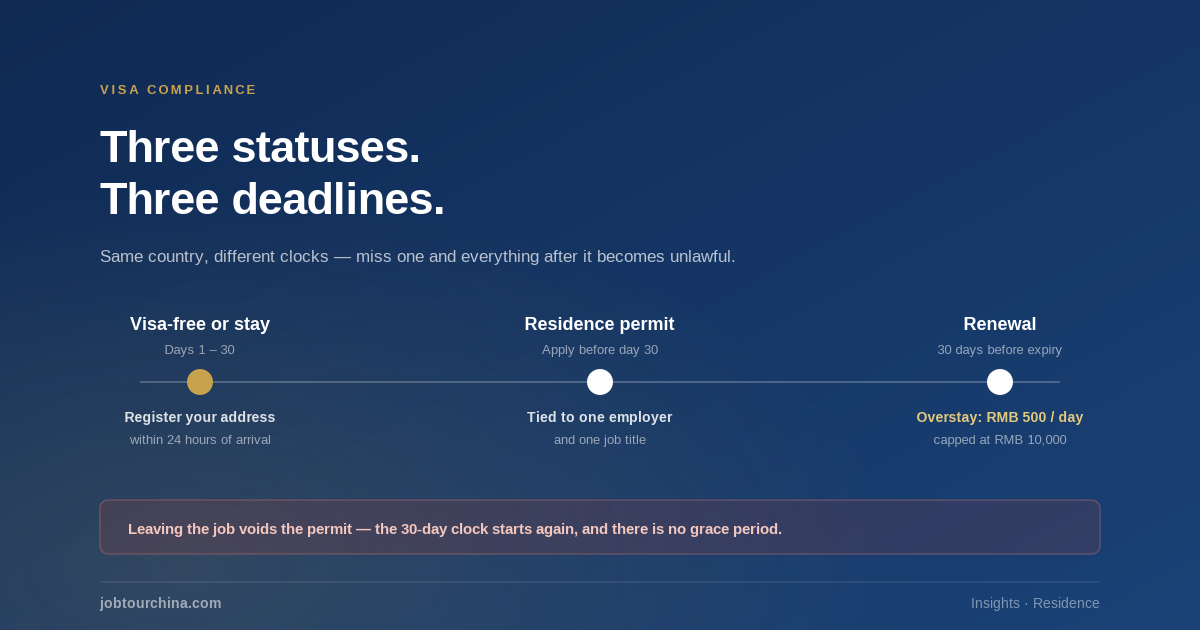
If you enter on a Z (work), X (study), Q1 (family reunion) or R (talent) visa, the visa is only the entry document. You have 30 days from entry to apply for the residence permit at the exit-entry administration of the public security bureau where you will live. The permit is what actually authorises you to stay.
Residence permits come in five purpose categories: work, study, journalism, family reunion and private affairs. Each is bound to its stated purpose. A study permit does not carry work rights unless the permit is specifically endorsed, and a work permit is tied to the employer and role it was issued for.
The trap that catches foreign employees: a job ending
Your work-type residence permit is built on your work permit. When the employment ends and the work permit is cancelled, the residence permit loses its foundation. What remains is a short transitional window — commonly 30 days — to either leave, or convert to another status with a new employer sponsoring you.
This is where people get caught: they treat the printed expiry date on the residence permit as the deadline, resign in month three of a two-year permit, and discover that the clock started when the work permit was cancelled, not when the card expires. If you are changing jobs, the sequence matters more than the dates — see our note on dispatch and contracting structures for why the sponsoring entity has to match the entity you actually work for.
The red line
Your activity must match your status. Working on a tourist visa, working without approval on a student visa, or staying past a visa-free window are all illegal — the first two as illegal employment, the last as illegal stay. There is no "small" version of this that stays administrative forever.
What it costs
| Violation | Statutory consequence |
|---|---|
| Illegal stay (overstay) | Warning; in serious cases RMB 500 per day of overstay, capped at RMB 10,000, or detention of 5–15 days |
| Illegal employment — the foreign national | Fine of RMB 5,000–20,000; in serious cases detention of 5–15 days plus a fine of RMB 5,000–20,000 |
| Illegal employment — the employer | RMB 10,000 per illegally employed foreign national, capped at RMB 100,000; illegal gains confiscated |
| Introducing someone to illegal work | RMB 5,000 per person introduced, with statutory caps for individuals and entities |
| Deportation | Re-entry ban of one to five years from the date of deportation |
Basis: Exit and Entry Administration Law, Articles 62, 78 and 80. Local discretion standards apply in practice; the figures above are the statutory framework, not a quote for any individual case.
Two things people forget within the first week
- Register your address within 24 hours. Hotels do it for you; if you stay anywhere else, you or your host must register with the local police station within 24 hours of moving in. This record is checked later, including at permit renewal.
- Carry your passport or residence permit. Foreign nationals aged 16 and over are required to produce identification on request.
A short checklist for employees and HR
- Diary the residence permit expiry and start the extension 30 days out — not 3 days out.
- Diary the work permit expiry separately; the two documents can fall out of sync.
- On resignation or termination, confirm in writing the date the work permit is cancelled, and count the transitional window from that date.
- Before accepting a new role, confirm which legal entity will sponsor the permit — the entity on the contract must be the entity on the permit.
- Keep the accommodation registration slip; you will be asked for it again.
This article is general guidance based on the rules in force at the date above, not legal or immigration advice. Local exit-entry authorities apply discretion, and practice varies by city. Confirm your own case with the competent authority or a qualified professional.
Related reading: Fake invitation letters and visa fraud · Work permit categories A/B/C · Work visa overview · All insights.
Sources
- Exit and Entry Administration Law of the People's Republic of China — National Immigration Administration, official English text. Articles 29, 30 and 32: stay duration, the 30-day residence permit clock and extensions.
Official text, checked 18 November 2026. Quoted for reference only; the Chinese original prevails.