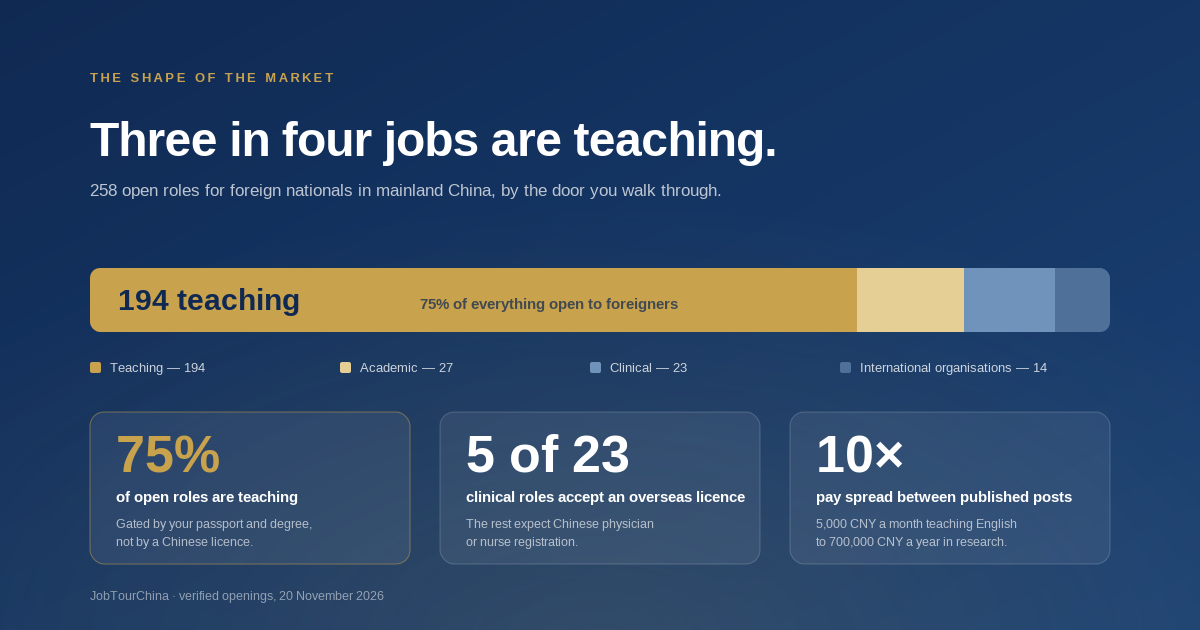
China's job market for foreigners has a shape, and the shape is lopsided. On 20 November 2026 we tracked 258 open roles across international schools, public universities, embassies, international organisations and private hospitals. 194 of them — three in four — were teaching jobs.
That is not because Chinese employers prefer teachers. It is because teaching is the one profession where the entry test is your passport and your degree, rather than a Chinese licence. Everything else runs into a wall that most applicants only discover after a hundred unanswered applications.
This page maps that wall, and shows where the doors actually are.
The four doors, and how wide each one is
| Door | Open roles we track | What it asks for | Real constraint |
|---|---|---|---|
| Teaching — international schools, plus university language posts | 194 (75%) | Bachelor's degree, native speaker of the language you teach, TEFL or two years' experience | Nationality and age filters; salary usually unpublished |
| University academic posts — faculty, research fellows, postdocs | 27 | PhD in the discipline, publications, ability to teach in English | Small number of posts; often region-specific hiring drives |
| Clinical work — hospitals and clinics | 23 | Usually a Chinese physician or nurse registration | Only 5 of the 23 accept a licence earned abroad |
| International organisations | 14 | Professional experience, English working proficiency, merit-based selection | Tiny supply, global competition, rigid process |
Read the third column again. Three of the four doors are gated by a qualification you probably do not have yet. The first door is gated by something you were born with.
Why teaching is the only wide door
Look at what the teaching ads actually demand. Yanshan University, hiring for English, Japanese, Russian, German and French: bachelor's degree or above, the native or first language of the language taught, two years' teaching experience or a recognised teaching certificate, under 60.
Wenzhou Medical University is blunter still. Its English post states the nationality restriction outright: Canada, the United Kingdom, the United States, Australia, New Zealand or Ireland. Its Japanese post states nationality: Japan.
That is the mechanism in one line. A foreign-language teaching post is built around your native language, so the permit route is short: degree, language, teaching certificate, clean record. No Chinese professional exam stands between you and the job.
The licence wall, precisely
Healthcare is where the wall is easiest to see, because we track it role by role. Of 23 open hospital roles, the split is:
| Category | Roles | What it means |
|---|---|---|
| Explicitly open to foreign nationals | 9 | The ad says so, or the employer's international clinic recruits on that basis |
| Requirements not stated | 9 | No nationality or licence clause — which in practice usually means Chinese registration is assumed |
| Licence-gated on its face | 5 | The ad names a Chinese credential you cannot obtain abroad |
And even inside the nine "explicit" roles, only five accept a licence earned in your country of training: a medical oncologist, a head of pharmacy, a rehabilitation specialist, a chiropractor, and a general practitioner. The other four are open to foreigners in principle but still expect Chinese registration.
The gated ones are explicit about what blocks you. Two physician posts require a Chinese physician practice certificate plus an attending-physician title. Two nursing posts require Chinese nurse registration. A site-doctor post uses English as its working language and serves expatriate patients across five provinces — and still requires a Chinese physician certificate.
The same pattern governs law, architecture and accountancy: the Chinese credential is the gate, and a foreign one is not a substitute. An overseas licence is a credential, not a work authorisation.
The nine roles that say nothing
The "not stated" column is the trap. Nine hospital roles publish a title, a city and a headcount, and say nothing about nationality or licensing. Applicants read that silence as an opening. It usually is not — it means the recruiter assumed a Chinese-registered candidate and did not think to spell it out.
Treat silence as a question to ask before you invest time, not as permission. One email — "does this post require a Chinese practice certificate, or would a licence from my country of training be considered?" — saves weeks.
The pay ladder is ten times tall, and it tracks the door
Salary disclosure is rare: 37 of 263 roles publish a figure, 14%. But where universities do publish, the spread is enormous. All of the following are official pages:
| Post | City | Published pay |
|---|---|---|
| Native English teacher, Tonghua Normal University | Tonghua | 5,000 CNY / month, paid over 10 months |
| Language teacher | Guilin | 5,500–8,000 CNY / month |
| English teacher | Shaoyang | 7,000–8,000 CNY / month |
| English faculty, Wenzhou Medical University | Wenzhou | 10,000–17,000 CNY / month |
| Foreign faculty, School of International Relations | Dalian | 10,500 CNY / month (PhD or associate professor) |
| Oral English teacher | Nanjing | 130,000–200,000 CNY / year |
| Associate professor appointed by ZJNU | Jinhua | 228,000 CNY / year |
| Teaching-track faculty, Zhejiang University ISM | Yiwu | up to 500,000 CNY / year |
| Postdoctoral research fellow, Zhejiang University ISM | Yiwu | up to 700,000 CNY / year |
A 5,000 CNY monthly post in Tonghua and a 700,000 CNY annual post in Yiwu are both public university jobs advertised to foreigners in the same season. The difference is not talent. It is which door you walked through: language instruction at a provincial teachers' college, or a research post at a medical school that is deliberately recruiting internationally and says it will support a permanent residence application.
Note also where the transparency sits. Not one of the 161 international-school roles publishes a salary. Half of the university language posts do. If you want to negotiate from information rather than hope, the university sector is currently the only one that gives you numbers.
What the international schools do offer
They offer a ladder. Of 161 school roles, 39 are leadership posts — heads of section, principals, directors — and 11 are specialist or support roles such as counsellor and librarian. The rest are classroom teachers.
That structure matters more than the missing salary figures. A school that hires a teacher can later hire that person as a coordinator, then a head of section. A university language centre rarely has that ladder. If your plan is five years rather than one, the school route has somewhere to go.
Three honest strategies
- If you teach: choose the sector deliberately. International schools pay more at the top but publish nothing; university language posts pay less but publish, often include housing, and give long holidays. Do not apply to both with the same CV — schools want curriculum experience, universities want a degree and a teaching certificate.
- If you are a licensed professional: either target the small set of international clinics that hire on a home-country licence — they exist, and we track five — or accept that mainland clinical practice means Chinese registration, which means an exam, usually in Chinese, and usually a re-entry route rather than a lateral move. Anything else is a detour.
- If neither: the remaining doors are international organisations and intra-company transfer. Both are small. The realistic third option is to enter China as a student or through a company that already employs you, and build the China-specific role from inside.
Check these six things before you apply
- Nationality clause. Stated or implied. "Native English speaker" is a legal filter, not a preference.
- Age. Under 60 is the common ceiling for teaching posts; some say 55.
- Degree level. Bachelor's for language teaching, master's or PhD for faculty and most clinical posts.
- Years of experience. Two is the usual minimum for language teaching; five for clinical.
- Licence. Does the ad name a Chinese certificate? If yes, and you do not hold it, the application is over.
- Whether the salary is published. If it is not, ask before the second interview. A role that will not name a range early rarely names a good one later.
The document file that follows an offer — what expires, and in what order to collect it — is covered in China work permit documents, in the right order.
The honest summary
China is an open market for foreign teachers and a closed one for foreign professionals, and the line between them is drawn by credential recognition rather than demand. There is real demand for foreign doctors, engineers, architects and lawyers — you can see it in the international clinics and the joint-venture hospitals. What is missing is a route for a licence earned elsewhere to be recognised here.
So the useful question is not "can foreigners work in China" — they can. It is "which of my qualifications transfers, and which has to be rebuilt?" Answer that first, and the job search becomes a shortlist instead of a scattergun.
Where these figures come from
Every count on this page is drawn from the four boards we maintain and check by hand, not from an estimate:
- International schools — 161 open roles at 63 schools
- Public universities — 60 open roles across 28 cities
- Hospitals and clinics — 23 open roles, each labelled by licence path
- Embassies and international organisations — 14 open roles
Pay examples are quoted from the institutions' own notices:
- Tonghua Normal University — English teacher, 5,000 CNY a month
- Zhejiang University, International School of Medicine — research fellow, up to 700,000 CNY a year
This page is provided for general information only, not as legal or immigration advice, and does not guarantee any application outcome.
Our four boards list only roles where we could verify the employer and the application route, and we label clinical posts by licence path rather than leaving you to guess. They are a sample of the market, not the whole of it — the figures above are what that sample shows as of 20 November 2026.