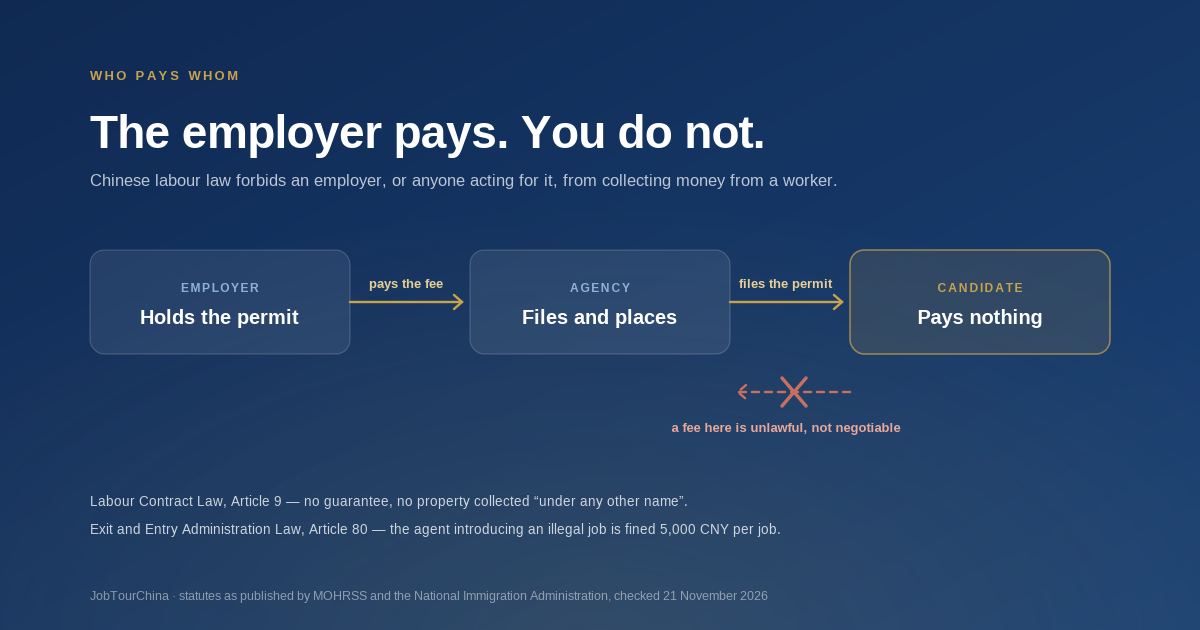
The one thing you cannot check from abroad is whether the employer is real and whether the job exists. That gap is the product. Almost every scam in this market is built inside it.
This page is about money: what people are asked to pay, what Chinese law says about each request, and how to verify an employer before you send anything.
The four things people are asked to pay for
| What you are asked for | How it is framed | Is it ever legitimate? |
|---|---|---|
| A placement fee | “Agency processing”, “introduction fee”, “service charge” | Not from the candidate. Chinese agencies are paid by the employer |
| A guaranteed-visa package | “We handle the work permit, 100% approval” | No. The permit is decided by a government office, not by an agent |
| A deposit before a contract | “Security deposit”, “training fee”, “uniform fee” | No. The law forbids employers collecting money from workers |
| Paying to convert a tourist visa | “We will switch your visa once you arrive” | No. That is not a service, it is illegal employment |
None of these is a grey area. Each one is either prohibited outright or impossible to deliver — which is why the sellers rely on you not knowing the difference.
What the law actually says
Two statutes cover this, and both are short enough to check.
The employer may not take your money. Article 9 of the Labour Contract Law states that when hiring, an employer may not require a worker to provide a guarantee, nor collect property from the worker under any other name. Article 84 sets the consequence: the labour authority orders the money returned and fines the employer 500 to 2,000 CNY per person.
The state may fine everyone in the chain. Under Article 80 of the Exit and Entry Administration Law, a foreigner working illegally is fined 5,000 to 20,000 CNY; in serious cases, detention of 5 to 15 days plus the same fine. The same article penalises the people who arranged it: an individual who introduces a job to a foreigner who is not eligible is fined 5,000 CNY per job, capped at 50,000; a company doing the same is capped at 100,000. An employer who hires illegally is fined 10,000 CNY per foreigner, capped at 100,000.
And Article 62 adds the part that outlasts the fine: a person repatriated for illegal work may not re-enter China for one to five years.
Why “guaranteed” cannot be true
A work permit is an administrative decision made by a local government office, on the documents in front of it and against a published points table. No agency has authority over that decision, and no agency can bind it.
So when someone guarantees approval, one of two things is happening. Either they are describing an ordinary application as if it were influence, and will refund nothing when it fails. Or they intend to supply a document that looks like an approval and is not — which is a different crime and a much worse position for you. Fabricated invitations and notifications are covered separately, because the paperwork itself has become the product.
Verify an employer in about fifteen minutes
- Check the company exists, under that exact name. The national enterprise credit information system (gsxt.gov.cn), run by the market regulator, returns registration status, registered capital, address and legal representative. The name on the contract must match it character for character.
- Check the job on the employer's own website. A real vacancy usually exists somewhere on the organisation's own domain. If the only trace of it is the agent's page, treat that as a finding, not an inconvenience.
- Call the switchboard, not the recruiter. Ask for the HR department by name and confirm the vacancy exists. This single call defeats most fabricated offers, because the scam depends on you never contacting anyone but the seller.
- Look at the email domain. A recruiter writing from a company domain is meaningfully different from one writing from a personal mailbox or a free webmail account. Ask for a document with the company seal; a real employer can produce one.
The red flags, in the order they usually appear
- You are asked for money before a contract exists.
- The fee is described as refundable “after you start”.
- Approval is promised, or a timeline is guaranteed in writing.
- Urgency: “the quota closes Friday”, “two other candidates are ready”.
- The employer is never named, or named only in a screenshot.
- The contact is a personal WeChat account with no company email behind it.
- The contract is offered only in English, unsigned, or without a seal.
- You are told to enter on a tourist visa and “sort the permit locally”.
- Your passport or degree certificate is requested by the agent “for safekeeping”.
- Payment is requested to a personal account rather than a company account.
What a legitimate process looks like
It is unglamorous, and that is the point:
- The employer, named, files the permit application itself through the official system.
- You pay nothing to the employer or to any agent acting for them.
- The contract is in Chinese, signed, sealed, and states location, duties, salary, dates and position.
- The notification letter and the permit are issued in the employer's name, following the published sequence.
- Nobody promises an outcome, because nobody can.
For comparison, what a verified opening looks like.
If you have already paid, or already started work
Both situations are recoverable, but the order matters.
- If you paid a fee: stop further payments, keep every record — chat logs, transfer receipts, the contract if any, the account name — and complain to the local labour authority on 12333. Article 84 gives them a basis to order repayment.
- If you are working without a permit: stop. The exposure is not theoretical: the fine runs to 20,000 CNY, detention is possible, and the entry ban outlasts both. Ask the employer to file immediately, and if they will not, treat that as the answer to what kind of employer they are. Immigration questions go to 12367.
- If you were sold a document: do not present it. Presenting a fabricated permit or notification turns a bad deal into your own offence.
Where these rules come from
- Ministry of Human Resources and Social Security — the Article 9 answer on collecting money from workers
- Exit and Entry Administration Law, official English text — Articles 41, 62 and 80, quoted above
- National enterprise credit information system — company registration lookup
This page is provided for general information only, not as legal or immigration advice, and does not guarantee any outcome. Penalties are applied by the authorities case by case; if a dispute is live, take local legal advice.