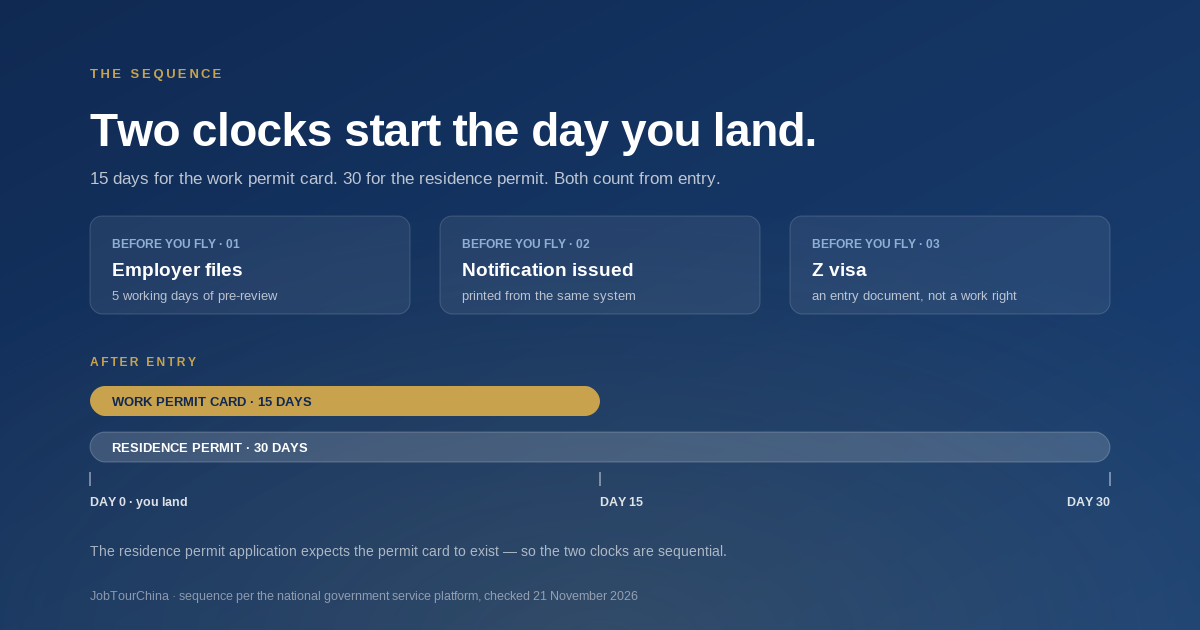
Most guides describe the Chinese work permit as one process. It is three, run by three different authorities, and the two clocks that matter do not start until you land.
That is why people who assemble a perfect document file still end up illegal for a fortnight: they were watching the embassy, when the clock had already moved to the entry-exit bureau.
The four steps, and who owns each one
| Step | Who acts | Where | What you get |
|---|---|---|---|
| 1. File the permit application | Your employer (or an agent they appoint) | The national foreign work permit system, then a counter visit | An approved application |
| 2. Collect the notification | Your employer | Printed online from the same system | The work permit notification letter |
| 3. Apply for the Z visa | You | A Chinese embassy or consulate in your country | A Z visa in your passport |
| 4. Convert on arrival | Employer, then you | Foreign experts office, then the entry-exit bureau | Work permit card, then residence permit |
Three different bodies appear in that table: the science and technology (foreign experts) administration, the embassy, and the public security entry-exit administration. Each keeps its own queue. A delay in one does not extend the clock in another.
Two clocks, both starting on the day you enter
The official sequence is explicit, and it is tighter than most people expect:
- Within 15 days of entry, your employer applies online for the work permit card and collects it from the local foreign experts office.
- Within 30 days of entry, you attend the entry-exit administration at your employer's location to obtain the work-type residence permit.
Both count from the date of entry, not from the date you start work. And they are sequential, not parallel: the residence permit application expects the work permit card to exist. Miss the 15-day step and the 30-day step becomes very hard to hit.
A Z visa is not permission to work
The Z visa gets you through the border. It is an entry document. What legalises your employment is the work permit card plus the work-type residence permit, and until those exist you are not cleared to work — even though you are standing in the office.
This matters because the temptation is obvious: you have arrived, the team is short-staffed, someone suggests starting on Monday. Working before the permit is issued is illegal employment, and the penalty falls on the employee as well as the employer. The safe answer is to wait for the card.
Where the sequence actually breaks
In practice the failure is rarely the law. It is one of five handoffs:
- The employer has never used the system. Registration and account verification come first, and they are not instant. Ask on day one whether the company has an active account, not whether they are “willing to sponsor”.
- Pre-review takes five working days. The receiving office has five working days to review the online submission before anything moves to a counter. Build that into the plan rather than treating it as dead time.
- Names and passport numbers must match exactly. The notification letter, the visa application and the passport are read side by side. One middle name or one hyphen out of place sends the file back.
- The embassy asks for something the permit file did not need. Consular requirements are separate from the permit requirements. Check the specific embassy's list, not a generic one.
- Accommodation registration is missed. The 24-hour registration at the local police station is a precondition for the residence permit, and nobody chases it for you. Do it the day you arrive.
Everything that has to be inside that file — and which of the items expire while you wait — is covered in China work permit documents, in the right order.
What the 15 days actually buy you
The work permit card is the document that proves you are employed in the role the state approved. It carries your employer, your position and a validity period — and it binds you to that employer. Change jobs and the card has to change; the residence permit follows it.
Keep both, plus the registration slip, in the same folder. You will be asked for them at the bank, at the telecom counter, and at the next renewal.
If you are already in China on another visa
The standard route assumes you are outside the country. There is an in-country route, but it is not a general right: high-end talent (Category A) can apply for the permit while already inside China on another visa or residence permit, and some other categories have their own provisions. What is not true is the common belief that a tourist visa can simply be converted because an employer is keen.
Ask the employer to confirm the route with the local foreign experts office before you plan anything. Which category you fall into decides this, not your negotiation with HR.
Category A moves faster and lasts longer
For high-end talent the differences are concrete: a decision within 5 working days, a permit that can run up to 5 years, and the in-country application route described above. That is not a marketing claim — it is written into the published service standard.
If you are close to the Category A threshold, the points are worth chasing before you file, not after.
After the sequence: the dates to diarise
- 30 days before the work permit expires: the employer applies for renewal. This is their obligation, and it is the one most often forgotten.
- 30 days before the residence permit expires: you apply for extension.
- Within 10 working days of a change of name, passport number or position: the employer files a change with the foreign experts office.
- Within 10 days of a new passport or a change in registered address: update the entry-exit administration.
Renewal is where a clean file pays off. The five things that fail a renewal review are almost all consistency problems, not eligibility problems.
Where these rules come from
- National government service platform — the four-step sequence, the five-working-day pre-review and the Category A provisions
- Guide for foreign business people in China (2026 edition) — the 30-day and 30-day-before rules
This page is provided for general information only, not as legal or immigration advice, and does not guarantee any application outcome. Timelines are applied by the local authorities where you file and can differ in practice; confirm with your employer before booking travel.