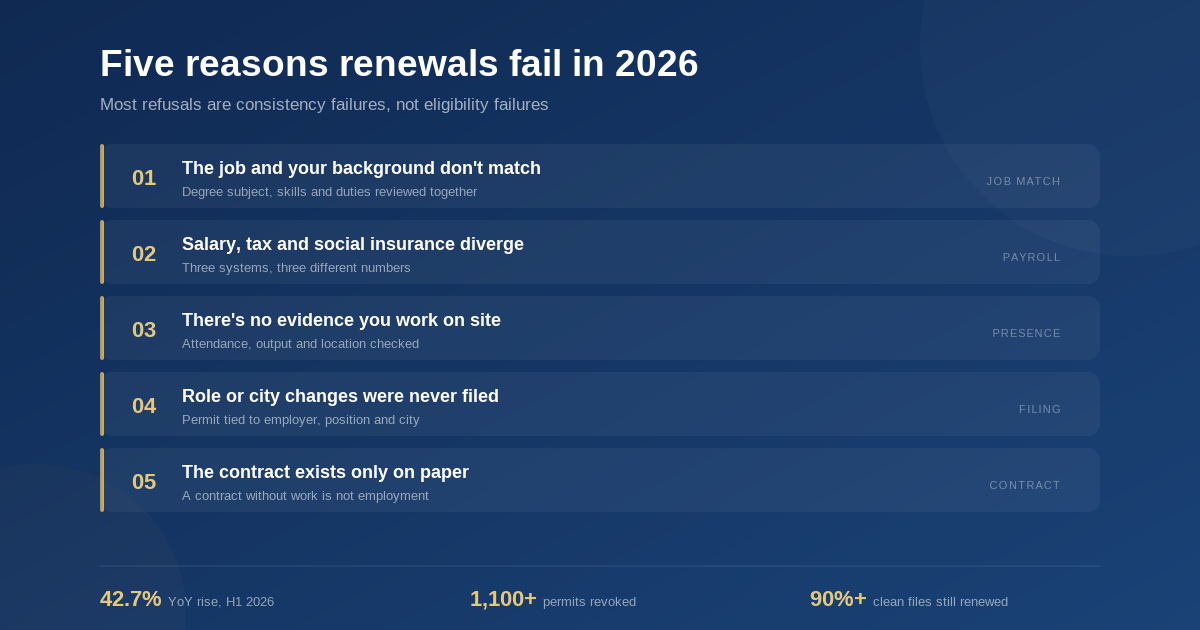
A work permit renewal used to be a paperwork exercise: show that the company still exists, show that you still work there, collect the stamp. In 2026 that stopped being enough. Reviewers now compare your file against tax filings, social insurance contributions and payroll records, and the files that fail are usually the ones where those records disagree — not the ones where the applicant was never eligible.
Below is what changed, the five patterns behind most 2026 refusals, and what a renewal-ready file looks like. The figures come from compliance reporting published in October 2026 that aggregated local government notices from Shenzhen, Wuxi, Jiangsu and Guangzhou; they are that reporting's numbers, not a national statistical release.
What changed in 2026
Three shifts matter more than the rest.
- From complete to consistent. A file can contain every required document and still fail, because the salary declared to the permit system does not match the salary on your tax record.
- Cross-system verification. Employer declarations, individual income tax, social insurance bases and bank payroll records are compared against each other instead of being reviewed one at a time.
- Enforcement against shell arrangements. Public security and foreign expert bureaus have run targeted campaigns against sponsorship-for-hire and employers that exist mainly on paper.
The reporting put the year-on-year rise in renewal rejections at 42.7% for the first half of 2026, with more than 1,100 permits revoked nationwide across the year. Read those as directional rather than precise: they aggregate local disclosures, and disclosure practice differs by city.
1. The job and your background don't line up
This is the most common refusal reason in the 2026 reporting. Previous reviews checked the job title against the permit category. Current reviews look at whether your degree subject, vocational skills and past experience actually match the duties you perform.
The pattern hits roles that are common in foreign-run companies but loosely defined on paper: operations, sales, account management, general administration. A business graduate hired as an operations manager is fine if the job description is genuinely operational. It is not fine if the description was reverse-engineered from the permit category while the actual work is something else.
Wuxi's random inspection data, as cited in the reporting, attributed more than 30% of local renewal refusals to some form of job mismatch.
2. Salary, tax and social insurance don't reconcile
This is the pattern that surprises people, because nothing in it looks fraudulent on its face. To meet a higher talent category, an employer declares a salary at or above the threshold. Payroll then continues at a lower figure, individual income tax is filed on that lower figure, and social insurance is paid on the local minimum base.
Individually, each number can be explained. Together they describe a job that pays three different amounts. Reviewers treat that as a question about whether the employment is real, and the burden of answering it falls on the applicant.
Intermittent anomalies get the same treatment: a month with zero tax filed, a month with no salary paid, a gap in social insurance contributions. Continuity is part of the evidence.
3. There's no evidence you actually work there
A complete contract, continuous social insurance and clean tax records are no longer sufficient on their own. If you live in another city, leave the country frequently, have no attendance record and cannot point to work you produced, the file reads as a sponsorship rather than a job.
The 2026 Shenzhen campaign is the clearest example in the reporting: 28 companies were added to a non-compliance list and 62 foreign employees had permits revoked in the second quarter alone.
What counts as evidence is unglamorous: attendance or access logs, email and project records, performance reviews, a desk in an office that the company actually operates.
4. Role changes and part-time work were never filed
A work permit is tied to an employer, a position and a city. None of those can drift silently. A significant change in duties, a move to another department, a second job on the side, or a relocation to a different city all require a filing before they happen — not a retroactive explanation at renewal.
The common misconception is that staying with the same employer removes the obligation. It does not. The permit describes a specific job, and reviewers check whether the job still matches.
5. The contract exists only on paper
In May 2026 a court in Taizhou, Jiangsu, addressed the extreme version of this: a signed labour contract with no actual work, no output and no attendance. The court held that the relationship was not a genuine employment relationship and that it constituted a fictitious basis for residence. The contract was invalid, and both the work permit and the residence permit were revoked.
The case matters beyond Taizhou because it gives reviewers a judicial anchor. A contract is now the beginning of the evidence, not the whole of it.
What a renewal-ready file looks like
Six things, in rough order of how often they are missing.
- A job description that matches your degree and history. Written by the employer, not copied from a template, and consistent with what you actually do.
- Twelve months of payroll that agrees with tax and social insurance. Same figure, three systems. If they diverge, fix the cause before you file, not the paperwork after.
- On-site evidence. Attendance, access logs, project records, reviews — anything that places you at the workplace over time.
- Filings for any change. New position, new city, additional employer: each needs its own approval, in advance.
- A contract whose terms match reality. Salary, duties and location should describe the job you have.
- Timing. Start two to three months before expiry. Late filings invite scrutiny; rushed corrections look like what they are.
Who still gets renewed
The tightening is aimed at irregular employment, not at foreign professionals generally. The same reporting notes that applicants with genuine on-site work, a defensible job match and consistent tax and social insurance records still clear renewal at above 90%.
That is the useful frame: the standard did not become "be exceptional". It became "be consistent".
Common mistakes
- Assuming the same employer means no filing. Role and city changes need approval even when the company does not change.
- Optimising social insurance for cost. Paying the minimum base while declaring a higher salary is the single most common consistency failure.
- Fixing documents instead of facts. A corrected payslip does not resolve a real gap in contributions.
- Waiting until the last month. Some fixes — a supplementary filing, a job description rewrite, a back-dated correction — take weeks.
- Treating the category threshold as the whole test. Clearing the points or salary threshold does not make an inconsistent file consistent.
What to do next
- Pull twelve months of payroll, individual income tax and social insurance records and put them side by side. Any month where the three disagree is your first problem.
- Ask HR for the job description on file and read it against your degree subject and work history. If they do not connect, rewrite it to describe the actual job — truthfully.
- List every change since the permit was issued: title, duties, department, city, any second engagement. Anything unfiled needs a filing.
- Collect evidence that you are physically and productively at work. Do this before anyone asks.
- Start two to three months before expiry, and keep the renewal file separate from the correction work so you can see which is which.
This article is general guidance based on the rules and reporting available at the date above, not legal or immigration advice. The statistics cited come from industry reporting that aggregated local government disclosures; they are not an official national dataset. Requirements and local practice change; confirm your own case with the competent authority or a qualified professional.
Related reading: Work permit categories A, B and C · Outsourcing, dispatch and contracting · Work visa overview · All insights.
Sources
- Exit and Entry Administration Law of the People's Republic of China — National Immigration Administration, official English text. Articles 41, 43 and 80: permit requirement, illegal employment and the penalties attached to it.
Official text, checked 18 November 2026. Quoted for reference only; the Chinese original prevails.