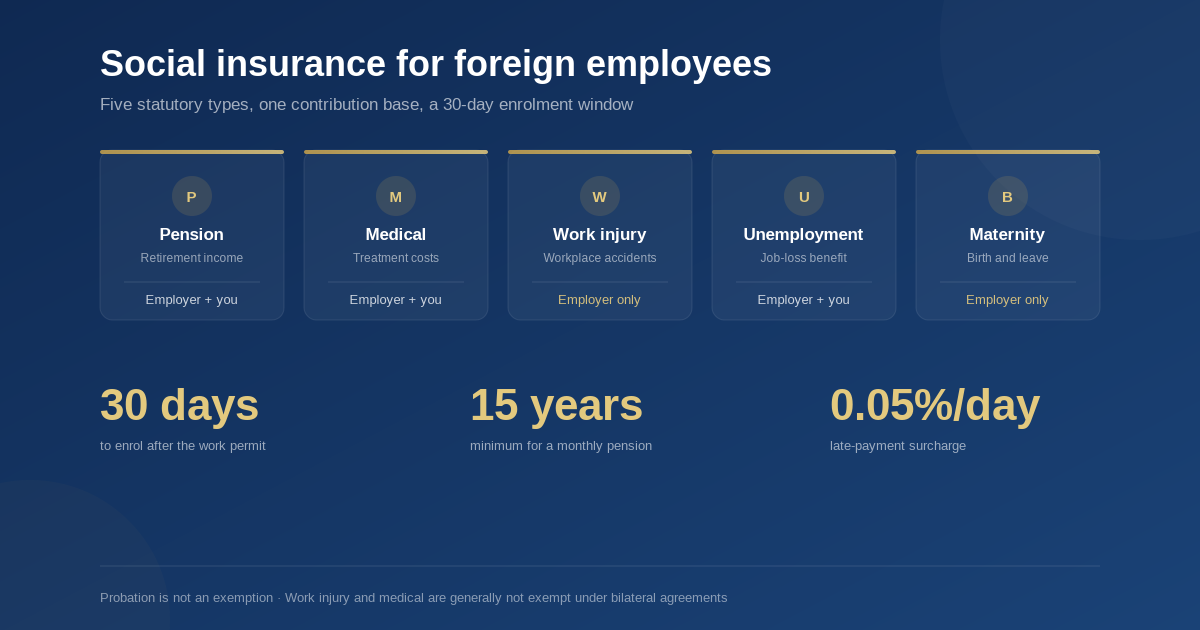
Social insurance is the part of a China employment package that people notice last and argue about most. Contributions are mandatory, the rules are national but administered locally, and the consequences of getting them wrong surface years later — at permit renewal, at retirement, or when someone changes nationality.
These nine questions cover most of what foreign employees and their HR teams actually ask. The answers follow the national framework administered by the Ministry of Human Resources and Social Security; local implementation differs, so confirm the details with your local social insurance office.
1. When must your employer enrol you?
Within 30 days of obtaining your foreigner work permit — and, in practice, within 30 days of the employment relationship starting. The employer registers you with the local social insurance collection agency and declares your contribution base.
The base is your average monthly salary for the previous year, and all five statutory insurance types are calculated on it. Standard documents are the work permit, the company's own social insurance registration certificate and the corporate bank account details.
2. What does medical insurance actually cover?
Once enrolled, you receive the same reimbursement treatment as a domestic employee for eligible medical expenses incurred while working in China. There is no separate foreigner scheme and no reduced benefit tier.
If enrolment was late, the account can generally be opened retroactively and the overdue contributions made up under local policy. That fixes the record. It does not necessarily fix a gap that a reviewer has already noticed.
3. Do contributions stop at retirement age?
No. Reaching China's statutory retirement age does not terminate the obligation. If you still hold a valid work permit and remain legally employed, pension and medical insurance contributions continue.
The test is the employment relationship, not the birthday. As long as the relationship exists and you are working, contributions are due.
4. Who pays work injury insurance?
The employer pays the whole premium. Nothing is deducted from your salary.
If you are injured at work and the injury is officially recognised, you receive the full statutory work injury benefit — at the same standard as a domestic insured employee. This is the one item where the answer is unambiguous, and it is worth confirming in writing at onboarding.
5. What if you have fewer than 15 years of pension contributions?
Fifteen years is the minimum for a monthly employee pension. If you reach retirement age below that, you cannot simply buy the difference. There are three lawful routes:
- Keep contributing annually until the total reaches 15 years. If you first enrolled before July 2011 and still fall short after five years of extension, a one-off top-up to 15 years is permitted.
- Transfer to the urban and rural resident pension scheme and receive benefits under those rules, which are lower.
- Terminate the employee pension relationship in writing and withdraw the personal account balance only. The pooled portion is not refundable.
The choice is effectively between a smaller monthly pension later and a lump sum now. It is worth modelling both before deciding.
6. What if your medical insurance years fall short?
Minimum contribution years for lifetime medical cover are set locally and vary by city. If you retire below the local threshold, you can keep paying until you reach it. Once you do, cover continues for life with no further contributions.
Because the threshold is local, this is one of the few questions where the answer genuinely depends on where your contribution record sits.
7. What happens if you change nationality?
Two directions, two answers.
- Becoming Chinese. Your existing contribution years and personal account balance are retained in full. You continue contributing under domestic citizen rules and claim a pension when eligible.
- Becoming foreign. You can either terminate the relationship in writing before leaving and withdraw the personal account balance, or keep the account and claim a pension later. If you keep it, you must complete an annual overseas survival verification to keep receiving payments.
Already-retired foreign pensioners living abroad face the same annual verification requirement.
8. What are the penalties for late or short payment?
The collection agency orders the shortfall to be made up and charges a late fee of 0.05% per day from the date the arrears began. If the employer still does not pay, an administrative fine of one to three times the overdue amount can follow.
Probation is not an exemption. It is part of the labour relationship, and contributions are due from the start.
9. Can a bilateral agreement exempt you?
China has bilateral social security agreements with a number of countries. If you are a qualifying cross-border secondee, you can be exempted from Chinese pension and unemployment contributions while remaining covered at home.
Work injury and medical insurance are generally not exempt and must still be paid locally. To claim the exemption, the employer obtains a Certificate of Coverage from the home authority and files it with the local social insurance agency in advance — not retrospectively.
What this means in practice
If you are the employee:
- Ask for your contribution base in writing at onboarding and check it against your actual salary.
- Keep your own record of contribution months. Do not rely on being able to reconstruct them years later.
- If you are seconded from abroad, ask early whether a Certificate of Coverage applies, because it changes what is deducted from your pay.
- If you are close to 15 years, get a statement now and model the shortfall while you still have options.
If you are the employer or HR:
- Enrol within the 30-day window. Late enrolment is fixable; a pattern of late enrolment is not.
- Keep the declared base, the tax filing and the payroll figure aligned. This is the same consistency test that work permit renewals now apply.
- Do not use probation as a reason to delay enrolment.
- File exemption certificates before the payroll cycle starts, not after a query arrives.
Common mistakes
- Assuming a foreign passport means a different scheme. There is no separate foreigner benefit tier; the standard is the domestic one.
- Treating the 15-year rule as a top-up problem. Arbitrary lump-sum top-ups are not permitted; only the three routes above are.
- Forgetting the pooled portion. Terminating the pension relationship returns the personal account only.
- Skipping the annual verification. Overseas pension payments stop if the survival check is missed.
- Assuming bilateral agreements cover everything. They typically cover pension and unemployment, not work injury or medical.
What to do next
- Get a written statement of your contribution base and months from HR or the local social insurance office.
- Check whether your country has a bilateral agreement with China and whether your assignment qualifies.
- If you are within a few years of retirement age, model the 15-year gap now.
- If you are changing nationality or leaving, decide between termination and retention before you go, not after.
This article is general guidance based on the national framework in force at the date above, not legal, tax or social insurance advice. Local implementation varies and thresholds change; confirm your own case with the local social insurance agency or a qualified professional.
Related reading: Paid from abroad, working in China · Work permit renewal reviews in 2026 · Salary & tax · All insights.
Sources
- Social Insurance Law of the People's Republic of China — Ministry of Human Resources and Social Security, official English text. Article 97.
- Should the employer pay social insurance contributions for foreign employees? — Ministry of Justice, English Q&A citing Article 97 of the Social Insurance Law and the Interim Measures for Social Insurance Coverage of Foreigners.
Official text, checked 18 November 2026. Quoted for reference only; the Chinese original prevails.