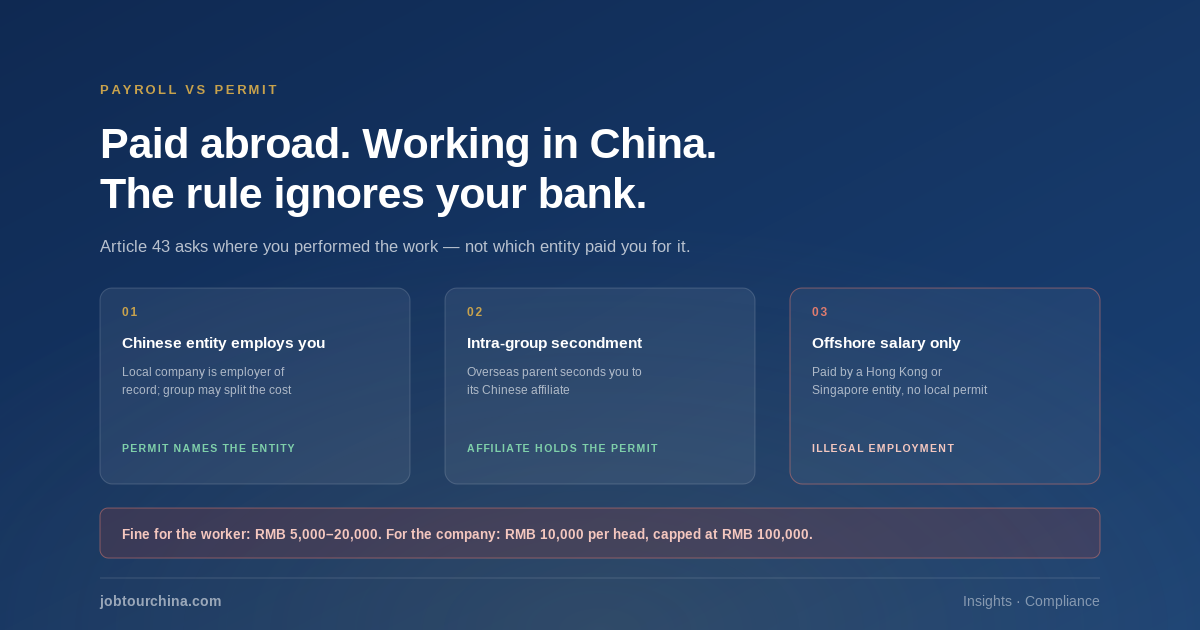
No. Being paid by a company outside China does not exempt you from China's work-permit requirement. Immigration law asks one question — where are you physically performing the work — and if the answer is "in China", you need a work permit and a work-type residence permit, regardless of which currency your salary arrives in or which entity signs the contract.
This matters more than it sounds, because the overseas-payroll arrangement is close to standard practice in South China's cross-border trade, e-commerce and sourcing sectors. A Hong Kong or Singapore entity hires you, the money lands offshore, you spend your weeks in Shenzhen or Guangzhou, and everyone involved treats the paperwork question as settled. It is not. The exposure falls on the Chinese company that benefits from your work, and it stays on your immigration record.
The rule looks at where you stand, not where you bank
Article 41 of the Exit and Entry Administration Law requires any foreign national working in China to hold a work permit and a work-type residence permit, and forbids any entity or individual from employing a foreigner who lacks them. Article 43 then defines illegal employment, and its first two limbs are the ones that matter here: working without those documents, and working outside the scope the permit was granted for.
Note what is absent from that definition. There is no carve-out for salaries paid offshore. There is no exemption for short contracts, for "consulting" invoices, for a title like regional representative, or for the fact that your employer has no Chinese legal entity. The three tests are: are you in China, are you doing work, and do you hold a permit that covers it. A fourth test is increasingly applied at the counter — does the entity named on your permit match the entity you actually work for.
Why the arrangement is so common in South China trade
Because it is genuinely convenient. A trading company in Dongguan with overseas customers wants a native speaker of the target market on the floor; it does not necessarily want to set up a payroll, a social-insurance account and a work-permit file for one person. Hiring through the Hong Kong trading arm is faster, and until something goes wrong nobody asks.
The 2026 wave of enforcement is what changed. Inspections now routinely check the permit's listed employer against the actual workplace, and cross-check tax and social-insurance records for the same period. An arrangement that survived for years on the grounds that nobody looked is a different proposition when someone does.
The three structures, and what each one requires
| Structure | Who holds the permit | Works if |
|---|---|---|
| Chinese entity employs you Group parent may reimburse or split cost internally |
The Chinese entity | The Chinese entity is the employer of record, the permit names it, and your contract describes the duties you actually perform. Offshore cost-sharing is a treasury matter, not an immigration one. |
| Intra-group secondment Overseas parent seconds you to its Chinese affiliate |
The Chinese affiliate | The affiliate files for your permit as the receiving entity, with a secondment letter that matches the permit's stated position. "Seconded" is a payroll word; it does not replace the local permit. |
| Short-term assignment A defined task with an end date |
The Chinese host | The assignment fits the short-term work route (90 days or less), is filed by the Chinese host, and the work performed stays inside what was approved. |
| Overseas salary, no Chinese permit | Nobody | Never, if you are physically working in China beyond the scope of a business visit. |
What it costs when it goes wrong
Article 80 sets the penalties, and they run in both directions. The foreign national faces a fine of RMB 5,000 to 20,000; in serious cases, detention of five to fifteen days on top of the fine. The entity that engaged you faces RMB 10,000 per person, capped at RMB 100,000 per case, with any illegal gains confiscated. Anyone who introduced you to the arrangement can be fined separately.
The immigration consequence is usually the one that hurts longest. An illegal-employment record sits on your file and is read at every subsequent visa, permit and permanent-residence application. People have lost job offers over a record created by a former employer's shortcut.
What the tax side does with a foreign payroll
Paying you offshore does not move the work offshore for tax purposes either. If you spend 183 days or more in China in a calendar year, you are a Chinese tax resident and your worldwide income is reportable here. Below that threshold you are a non-resident and China taxes only China-sourced income — but income for work physically performed in China is China-sourced, whoever pays it.
Social insurance follows employment, not payment routing. A foreign national employed by a Chinese entity participates in the five categories; nationals of countries with bilateral social-security agreements may be exempt from some of them under the treaty. None of this is triggered by a foreign bank account, and none of it is avoided by one.
Six questions to ask before you sign
- Which entity will be named on my work permit? If the answer is "we'll sort that out later", the arrangement is not ready.
- Who signs my employment contract — the Chinese entity or the offshore one? If offshore, ask what the local filing looks like, in writing.
- Does the job title on the permit match what I'll actually do? Working outside the permit's scope is a separate violation from having no permit at all.
- Who withholds individual income tax, and in which city? A foreign payroll with no Chinese withholding is the pattern inspectors look for.
- Am I on the Chinese entity's social-insurance account? If not, ask why — and get the answer from someone who files these, not from the recruiter.
- What happens at renewal? Permits are renewed against a live, operating employer. A dormant entity cannot renew you.
What to do next
If you are already in this arrangement, the fix is usually administrative rather than dramatic: the Chinese entity registers as an employer, files for your permit, and you convert to a work-type residence permit. Doing it voluntarily is a materially different conversation from doing it after an inspection.
If you are negotiating a new role, put the permit question in the first email rather than the last. Employers who do this routinely answer it in one line; employers who cannot answer it are telling you something useful.
For the related question of whether a Chinese company can place you at a client site on someone else's permit, see outsourcing, dispatch and contracting. For the permit categories themselves, start with work permit categories.
This article is general guidance based on the rules in force at the date above, not legal or immigration advice. Requirements and local practice change; confirm your own case with the competent authority or a qualified professional.
Related reading: Outsourcing and dispatch · Work permit categories · Salary & tax · Work visa overview · All insights.
Sources
- Income tax consequences of residency in China — State Taxation Administration, English page on the 183-day and 30-day rules.
- Exit and Entry Administration Law of the People's Republic of China — National Immigration Administration, official English text. Article 41: the permit obligation attaches to work performed in China, not to where you are paid.
Official text, checked 18 November 2026. Quoted for reference only; the Chinese original prevails.