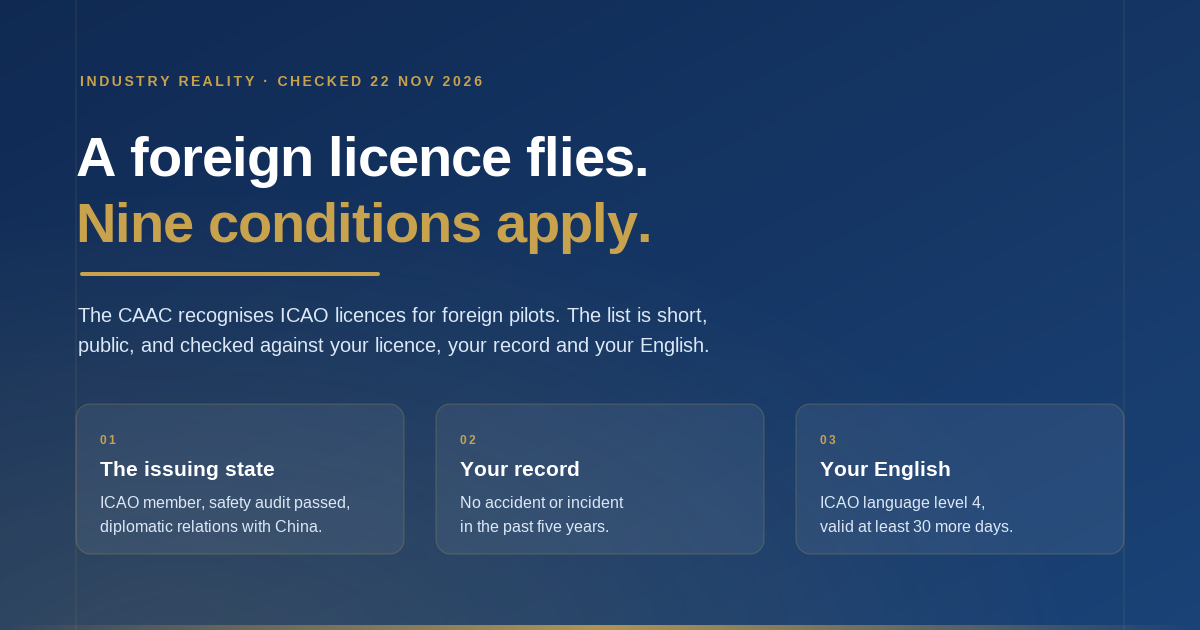
Yes — a foreign pilot licence can be recognised in China. But recognition is a documentary process with nine published conditions, and the licence on its own gets you no further than the first of them.
What follows comes from the Civil Aviation Administration of China's own administrative-approval guidance and its pilot licensing platform, both checked on 22 November 2026. No airline's recruitment advertising was used as a source, because the conditions that decide your case are set by the regulator, not by the airline.
What "recognition" actually means
The CAAC does not simply accept your national licence. It verifies the licence first and issues a licence confirmation letter. That letter is the document you then use either to apply for a Chinese licence or to obtain a recognition letter permitting you to fly in Chinese operations. The basis is CCAR-61, the 2012 CAAC opinion on foreign pilots taking part in Chinese flight operations, and advisory circular AC-61-01 on converting licences between ICAO states.
The application is made online through the CAAC pilot licensing platform. Paper confirmation letters stopped being issued in 2016, so what you receive is an online record or a printout of it. If you are converting to a Chinese private pilot licence only, the confirmation step is not required.
The nine conditions, in the regulator's own terms
| # | Condition | What it means in practice |
|---|---|---|
| 1 | Licence currently valid | No operating limitation that conflicts with ICAO requirements. |
| 2 | Issuing state qualifies | An ICAO member state with diplomatic relations with China that has passed the ICAO safety oversight audit. |
| 3 | Ratings match the job | The ratings on your licence must cover the operation you are being hired to fly. |
| 4 | Checks are current | Your check records must be legible, and the type checks valid. |
| 5 | No duplicate Chinese licence | You must not already hold a current CAAC licence carrying the rating you want recognised. |
| 6 | Clean licence history | The foreign licence must never have been suspended or revoked by its issuing authority. |
| 7 | Five-year accident record | No accident or incident in the previous five years. |
| 8 | ICAO English level 4 | Level 4 or above, with at least 30 days of validity left when you apply. A narrow exception exists for remote low-altitude operations, and it requires a written safety report accepted by the principal operations inspector. |
| 9 | Previous evaluation | On a renewal rather than a first application, your former operator's evaluation must be satisfactory. |
What the list does not contain
Three absences are worth noticing, because each one is commonly mistaken for a rule.
- No age limit. The nine conditions say nothing about age. The caps you see in recruitment adverts come from the airline, not from the regulator.
- No minimum flight hours. Hours are not part of recognition. They come from the employer and from the type rating, which is why two pilots who both clear the nine conditions can be treated very differently by two airlines.
- No Chinese-language test. Radiotelephony in Chinese airspace is conducted in English, and the language gate in the rules is ICAO level 4. Mandarin helps after you land, not before you are hired.
Recognition is not a work permit
This is the step most candidates conflate. CAAC recognition decides whether you may fly; it says nothing about whether you may live and work in China. That is a separate permission, applied for by the employer, and it runs in a fixed order: the employer obtains the foreigner work permit notification, you apply for a Z visa abroad, you enter, and within 30 days you convert to a residence permit. The sequence is set out in our work visa walkthrough.
Which work-permit category you fall into is decided by salary and qualifications under the points system, not by your licence type, and the employer runs that test. Our category guide explains what the tiers mean.
The realistic route to a flight deck in China
Recognition is a condition of employment, not an application channel. Airlines recruit directly and through specialist crewing agencies, and in practice the airline sequences the confirmation, the medical and the conversion for candidates it has already selected. That ordering matters: applying for recognition on your own, before an employer is interested, produces a document with no job attached to it.
What makes a candidate usable is a current type rating on an aircraft the airline actually operates, plus recent experience on it. A clean licence with a lapsed rating is a paperwork exercise; a current rating with a clean record is a hiring conversation.
Common mistakes
- Treating the licence as the whole qualification. Conditions 3 and 4 are where most first applications fail: the ratings do not cover the operation, or the checks have expired.
- Letting the medical slide. A valid medical is needed for the licence and again for the work permit. One expiry stalls both tracks at once.
- Paying an intermediary to "arrange recognition". The application is made on the regulator's own platform. Anyone charging a processing fee for it is selling you something you can do yourself — see why we tell people never to pay for a job.
- Assuming a foreign licence equals a Chinese one. Recognition permits you to fly; it does not convert your licence into a CAAC licence unless you complete the conversion.
What to do next
- Check your own file against the nine conditions before you contact anyone. Conditions 2, 6 and 7 eliminate candidates whom no employer can help.
- Confirm your type rating is current and your last check is within validity. If it is not, the conversion is premature.
- Apply to airlines and to crewing agencies that name the principal they recruit for, and ask which entity will hold your work permit.
- Read the visa sequence so you know what happens after an offer — recognition plus conversion is measured in months, not weeks.
Other sectors, same question
Each was checked the same way: official recruitment pages, and the rule that governs the sector.
- Can Tourism or Hospitality Get You a China Work Visa? — Hotels and local agencies hire locally. Three narrow openings remain.
- Working on a China-Based Cruise Ship: Who Hires Foreign Crew — Foreign crew, hired through crewing agencies, on rotational contracts.
- NGO Jobs in China: The Four Posts the Law Actually Names — One chief representative and up to three representatives per office.
- Exhibitions in China: Bilingual Work, Not Foreign Work — The business sells in English and operates in Mandarin.
- Coaching in China: The Visa a Coach Actually Needs — The sports M visa covers a trial, not a coaching season.
- Hotel Groups in China: The Door Is a Transfer, Not a Vacancy — Leadership is filled internally; the graduate route is closed.
- Treating Patients in China: The Licence Nobody Mentions — A one-year practice registration instead of a Chinese licence.
- Selling Abroad from China: The Sector Cities Recruit For — Cities recommend foreign livestream talent for work permits.
- Designing in China: Why the Stamp Is Not Yours — Design is international; the statutory stamp is not.
- Chambers of Commerce: A Channel, Not a Visa — A lead list of member employers, not a sponsor.
This article is general guidance based on the rules in force at the date above, not legal or immigration advice. Requirements and local practice change; confirm your own case with the competent authority or a qualified professional.
Sources
- CAAC administrative approval platform — recognition of foreign pilot, navigator, flight engineer and flight radio operator licences — the nine conditions, the document list and the handling process, in Chinese.
- CAAC pilot licensing platform — FAQ for the foreign licence confirmation system — the legal basis (CCAR-61, the 2012 opinion on foreign pilots, AC-61-01) and the online filing route.
- CAAC pilot licensing platform — forms and examination standards — where the confirmation application is filed and where the conversion examinations are scheduled.
Official pages, checked 22 November 2026. Requirements change without notice; the linked page prevails over this summary.
Related reading: Work visa overview · Salary & tax · All insights.