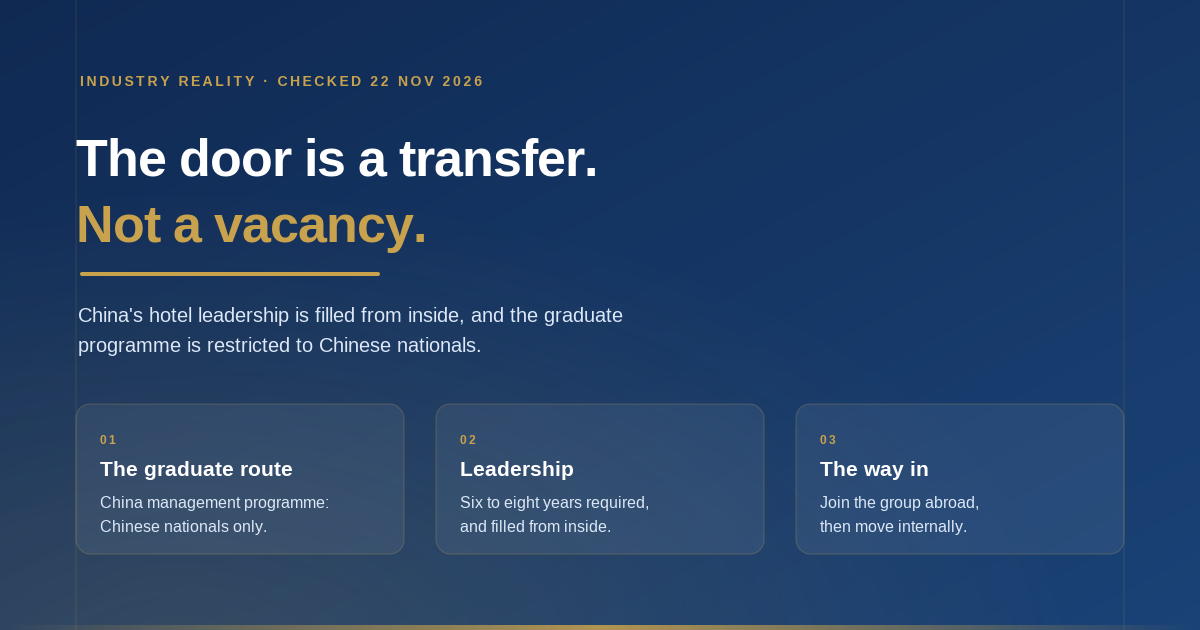
China has thousands of hotels carrying international brands and very few foreign managers who were hired from outside the country. That is not an accident of preference. The leadership pipeline is internal, and the graduate entry programme is restricted to Chinese nationals.
Everything below comes from the groups' own careers channels and programme documents, checked on 22 November 2026. The pattern is industry-wide, but the documents quoted are Marriott's, because they are the ones published in full.
The graduate door is nationality-restricted
Marriott's Greater China Voyage programme is the group's management entry channel: 18 months, more than 70 positions across 40-plus hotels and area offices, rotating through rooms, food and beverage, sales and marketing, revenue and HR. For the 2027 intake the published eligibility is explicit — Chinese nationality, including citizens of Hong Kong, Macao and Taiwan — alongside a degree, strong written and spoken Chinese and English, and willingness to relocate anywhere in Greater China.
That is the pipeline that produces the next generation of department heads. If you hold a foreign passport, you are not in it, and no amount of hotel-school prestige changes the eligibility line.
The leadership door assumes you are already inside
A Hotel Manager posting for Shanghai on the group's careers site asks for either a two-year degree plus eight years of management experience, or a four-year bachelor's degree plus six years. The duties are the ones you would expect: P&L, owner relations, brand standards, executive committee leadership.
What the posting does not contain is equally informative. There is no relocation clause, no visa sponsorship language and no international-candidate route. The vacancy is written for someone who can already work in China, or for someone already inside the company.
The route that does work: a transfer
The realistic path for a foreign hotelier is to join a group in a market where you already hold the right to work, build a record inside it, and then move to China on an internal assignment. That mobility is a company process, not a public vacancy: it is negotiated with a regional HR team, and the permit is handled as part of the package.
The second path is local. If you are already in China with a valid permit and working Mandarin, property-level roles in food and beverage, rooms or revenue are ordinary hires, and the group is the sponsor. Both paths have one thing in common: the job is never advertised as a China vacancy open to the world.
| Route | Who it suits | What it requires |
|---|---|---|
| Graduate management programme | Graduates entering the industry | Chinese nationality, degree, strong Chinese and English. |
| Internal transfer | Hoteliers with years inside a group | A record in the group, a mobility conversation, a package. |
| Local property hire | Foreigners already living in China | Existing work permit, working Mandarin, department experience. |
What this means for your job search
- Do not apply to a China graduate programme if you are not a Chinese national. The eligibility line is published; an application costs you time and nothing else.
- Target the group, not the country. Apply to the same brand in a market where you can work legally, then raise China as a medium-term move once you have a record.
- If you are already in China, apply at property level for the department where you have experience, and say plainly that you hold a permit and can work in Mandarin.
- Ask who the employer is. Many branded hotels are owned by Chinese developers and managed under contract; the management company, not the owner, is normally your employer.
Common mistakes
- Assuming an international brand means an international hire. The brand sets the standard; the local company does the hiring.
- Treating a hotel-school diploma as a work permit. It is a qualification. The permit comes from an employer that is willing to sponsor.
- Applying for a general manager role from outside without group experience. Those searches are run through executive channels and internal benches.
- Confusing a management contract with an ownership job. Owner-side roles exist, but they are hired by the developer, not the brand.
What to do next
- Pick three groups whose brands you know, and read their global careers site rather than a China job board.
- Identify the department where you are strongest, and apply in a market where you already have the right to work.
- Once inside, tell your regional HR contact that you want a China assignment, and ask what the mobility policy requires.
- For the permit mechanics, see the category guide; for the order of events, the visa sequence.
Other sectors, same question
Each was checked the same way: official recruitment pages, and the rule that governs the sector.
- Can Tourism or Hospitality Get You a China Work Visa? — Hotels and local agencies hire locally. Three narrow openings remain.
- Flying in China on a Foreign Licence: What the CAAC Requires — The CAAC recognises foreign licences on nine published conditions.
- Working on a China-Based Cruise Ship: Who Hires Foreign Crew — Foreign crew, hired through crewing agencies, on rotational contracts.
- NGO Jobs in China: The Four Posts the Law Actually Names — One chief representative and up to three representatives per office.
- Exhibitions in China: Bilingual Work, Not Foreign Work — The business sells in English and operates in Mandarin.
- Coaching in China: The Visa a Coach Actually Needs — The sports M visa covers a trial, not a coaching season.
- Treating Patients in China: The Licence Nobody Mentions — A one-year practice registration instead of a Chinese licence.
- Selling Abroad from China: The Sector Cities Recruit For — Cities recommend foreign livestream talent for work permits.
- Designing in China: Why the Stamp Is Not Yours — Design is international; the statutory stamp is not.
- Chambers of Commerce: A Channel, Not a Visa — A lead list of member employers, not a sponsor.
This article is general guidance based on the rules in force at the date above, not legal or immigration advice. Requirements and local practice change; confirm your own case with the competent authority or a qualified professional.
Sources
- Marriott International — global careers site — the group's careers channel and the China property vacancies referenced above.
- Macao University of Tourism — Marriott Greater China 2027 Voyage Programme announcement — the programme structure and the eligibility line restricting it to Chinese nationals, including Hong Kong, Macao and Taiwan.
- Marriott — Hotel Manager, Shanghai (posting mirror) — the education and experience requirements quoted, and the absence of any sponsorship language.
Official pages, checked 22 November 2026. Requirements change without notice; the linked page prevails over this summary.
Related reading: Work visa overview · Salary & tax · All insights.