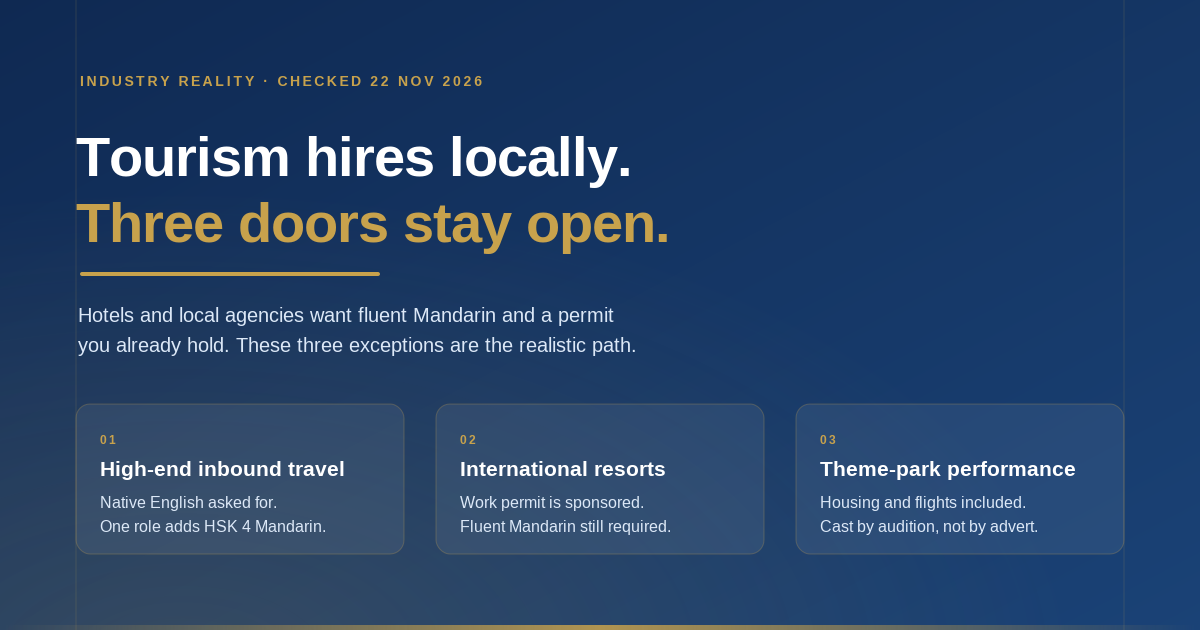
Almost nothing. Hotels and local travel agencies hire locally: they want fluent Mandarin and a candidate who already holds a Chinese work permit. Three narrow channels do recruit foreign nationals, and each has a specific entry condition you can check before you send anything.
This page is what came back from checking the official recruitment pages of inbound agencies, resort groups and theme parks in mainland China on 22 November 2026. Where a page states a language or work-authorisation condition, that condition is quoted below. Where we found no public route for foreign applicants, we say so instead of listing the employer anyway.
Why the obvious targets are the wrong ones
Start with the biggest inbound agencies, because that is where foreigners assume the work is. China Highlights (Haina Travel, Guilin) does advertise English travel-consultant roles — and asks for "CET-6 or TEM-4", the national English examinations sat by Chinese graduates. That is a job for a Chinese national with strong English. It is not a door for a foreign national, however good your English is.
The same pattern runs through the hotel groups. Their China vacancies are ordinary local hires: the listings we checked ask for Mandarin and for existing authorisation to work in China, and none of the groups we checked publishes a channel aimed at candidates who would need a work permit sponsored. One luxury resort group's internship listing goes further and states plainly that it does not sponsor visas or work permits for foreign interns.
This is not hostility. It is an employment premise: these employers assume you can already work here. When that premise fails, the vacancy is closed to you regardless of your qualifications.
The three openings that do exist
1. High-end inbound travel agencies
WildChina, a Beijing operator founded in 2000, was carrying seven mainland vacancies when we checked in November 2026. The language requirements differ by seniority in a way worth understanding. The Travel Designer posting asks for "native or fluent English" and does not mention Mandarin at all. The Ultra-Luxury Travel Designer posting requires "fluency in English" plus "Mandarin Chinese HSK 4 or above". The more senior and the more client-facing the role, the more Chinese is required.
Imperial Tours, also Beijing-based, recruits "China Hosts" who travel with groups. Its published conditions are unusually explicit: over 26, resident in China for several years, native speaker of English, fluent Mandarin. That is a fair summary of the ceiling in this channel — English gets you considered, Mandarin gets you hired.
2. International resorts
Resort groups are the one employer type that openly handles the permit. Club Med staffs its villages with an international team and says it arranges the work permit for hires; its China resorts recruit seasonal G.O roles through the group's own careers site. The catch is the language line: China-based roles ask for basic English plus fluent Mandarin. This is the widest channel in the industry if you already speak Chinese, and a closed one if you do not.
3. Theme-park performance
Shanghai Disney Resort casts character look-alike performers internationally on fixed-term contracts that include housing and flights. In our check this was the only channel where an employer recruits from outside China, for a job located in China, without asking for Mandarin.
It is not, however, a job advert. It is an audition: you attend a casting call in your own region and the contract follows. The most recent call we found was held in Burbank on 17 November 2026; on 22 November 2026 the official Disney Auditions page listed no Shanghai session. If you want this route you watch the audition calendar, not the job board.
| Channel | What it asks for | Work permit | How you apply |
|---|---|---|---|
| High-end inbound agency | Native or fluent English; HSK 4 or fluent Mandarin for senior roles | Not stated in the posting | CV by email to the agency's HR address |
| International resort | Basic English and fluent Mandarin (China resorts) | Arranged by the employer | The group's own careers site |
| Theme-park performance | Acting and movement ability; passport valid beyond the contract | Contract includes relocation and housing | Audition call, in person |
What this means for your job search
- If you do not speak Chinese, your realistic field is two rows wide: English-language roles at high-end inbound agencies, and theme-park performance. Everything else in tourism and hospitality filters you out at the language or permit line.
- If you speak Chinese at HSK 4 or above, resorts and senior agency roles open up, and this becomes one of the few non-teaching industries where a foreign professional can build an ordinary career.
- Do not treat hotel vacancies as a stepping stone. They are not a lower rung of the same ladder; they are a different labour market that assumes local work rights.
- Treat the audition channel as a separate process. It rewards presence, height and performance ability rather than a CV. A strong résumé does nothing there.
Common mistakes
- Reading "excellent English" as "foreigners wanted". The largest inbound agencies ask for CET-6 or TEM-4 — Chinese examinations. The phrase means close to the opposite of what it looks like.
- Assuming an international brand means an international hire. A resort can have colleagues from dozens of countries and still require fluent Mandarin for every China-based post.
- Paying an agent for a tourism placement. No legitimate employer in this sector charges a candidate. Read what you should never pay for before anyone asks you for money.
- Waiting for a Shanghai audition to appear on a job board. It will not. Auditions are announced on the casting calendar and held abroad.
What to do next
- Settle the language question first. Your HSK level decides whether this is a two-channel or a four-channel search. Without Chinese, do not spend weeks on hotel applications.
- Go to the three official pages directly — the agency's careers page, the resort group's own jobs site, and the theme-park audition calendar. Skip aggregators: the tourism listings there are overwhelmingly local hires.
- Write to the address the employer prints. WildChina and Imperial Tours both publish a specific HR mailbox in the posting; use it and put the job title in the subject line.
- If you need the permit sponsored, say so in the first email. It is the first thing a tourism employer checks, and hiding it wastes both sides' time.
Other sectors, same question
Each was checked the same way: official recruitment pages, and the rule that governs the sector.
- Flying in China on a Foreign Licence: What the CAAC Requires — The CAAC recognises foreign licences on nine published conditions.
- Working on a China-Based Cruise Ship: Who Hires Foreign Crew — Foreign crew, hired through crewing agencies, on rotational contracts.
- NGO Jobs in China: The Four Posts the Law Actually Names — One chief representative and up to three representatives per office.
- Exhibitions in China: Bilingual Work, Not Foreign Work — The business sells in English and operates in Mandarin.
- Coaching in China: The Visa a Coach Actually Needs — The sports M visa covers a trial, not a coaching season.
- Hotel Groups in China: The Door Is a Transfer, Not a Vacancy — Leadership is filled internally; the graduate route is closed.
- Treating Patients in China: The Licence Nobody Mentions — A one-year practice registration instead of a Chinese licence.
- Selling Abroad from China: The Sector Cities Recruit For — Cities recommend foreign livestream talent for work permits.
- Designing in China: Why the Stamp Is Not Yours — Design is international; the statutory stamp is not.
- Chambers of Commerce: A Channel, Not a Visa — A lead list of member employers, not a sponsor.
This article is general guidance based on the rules in force at the date above, not legal or immigration advice. Requirements and local practice change; confirm your own case with the competent authority or a qualified professional.
Related reading: Work visa overview · Salary & tax · All insights.
Sources
- WildChina — Careers — seven mainland postings at the check date, with links to the individual role pages.
- WildChina — Travel Designer (Beijing, Chengdu, Huizhou) — "Native or fluent English"; no Mandarin requirement stated.
- WildChina — Ultra-Luxury Travel Designer / Private Concierge — "Fluency in English required, with Mandarin Chinese HSK 4 or above".
- Imperial Tours — About us / Work with us — China Host conditions: over 26, resident in China, native English speaker, fluent Mandarin.
- Club Med — official careers site — resort roles and the G.O recruitment process.
- Disney Auditions — official casting calendar — no Shanghai session listed on 22 November 2026.
- Haina Travel (China Highlights) — 加入我们 — English travel-consultant roles requiring CET-6 or TEM-4.
Official pages, checked 22 November 2026. Requirements change without notice; the linked page prevails over this summary.