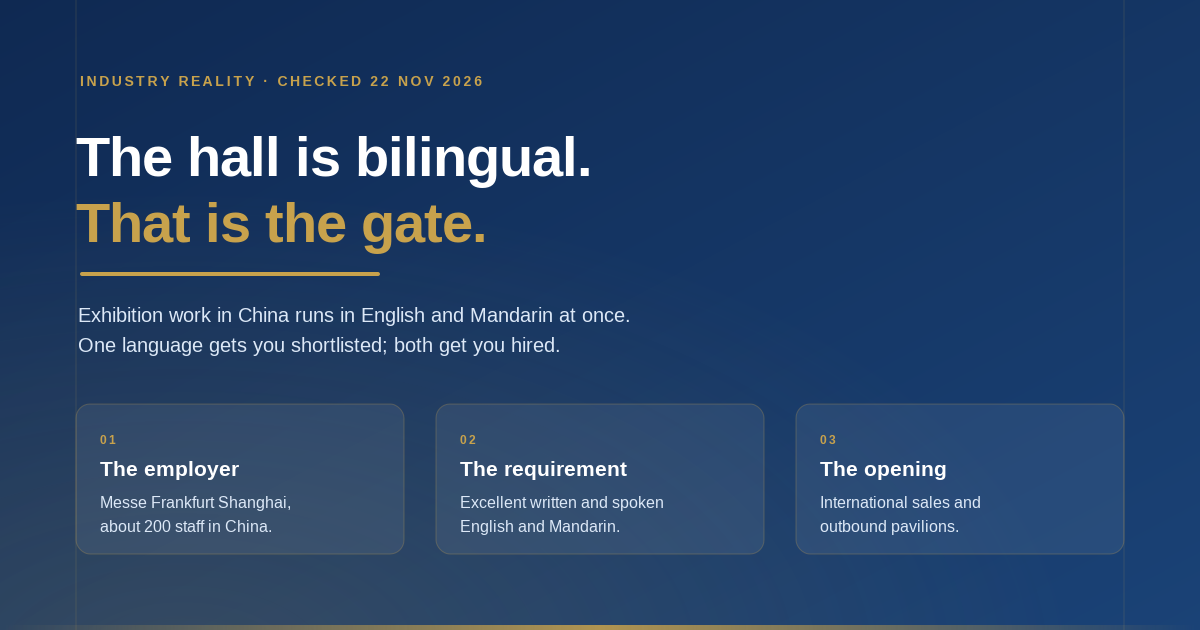
Exhibition work in China is neither closed to foreigners nor open to them. It is bilingual: the business sells in English and operates in Mandarin, and employers hire on that combination rather than on your passport.
What follows comes from the official careers pages of a major international organiser and from the government rules that govern short-term work, checked on 22 November 2026. Where a requirement is quoted, it is quoted as published.
Why the industry is bilingual by construction
A trade fair in Shanghai is two businesses running at once. One brings international exhibitors and buyers into China; the other takes Chinese exhibitors out to Frankfurt, Dubai and Moscow. Each end needs the language the other side lacks.
The local end does not run in English at all. Venue contracts, customs treatment for exhibits, fire and safety approval, exhibitor databases and WeChat promotion are handled in Mandarin with Chinese venue operators and regulators. A foreign hire who cannot follow that work is only useful in half of the job.
What the official pages actually ask for
Messe Frankfurt Shanghai, the group's mainland subsidiary since 2002, employs about 200 people including its Beijing office, and routes all applications to a single HR mailbox. Its careers page is short and does not describe an expatriate track. The requirement appears in the programme documents instead.
The Shanghai Graduate Trainee Programme is a 24-month rotation across three exhibition projects. Its candidate profile asks for three things that matter here: a degree from a leading university, willingness to rotate across divisions, and excellent command of both written and spoken English and Mandarin. That single line is the hiring gate for this industry, and it applies to graduates as much as to managers.
The same company's internship advertisements on Chinese job boards add CET-4 and fluent English to the list. Read together, the two sets of requirements describe a team that works in both languages simultaneously, not a foreign team with Chinese support.
The three job families, and where a foreign passport helps
| Job family | Language load | What a foreign applicant brings |
|---|---|---|
| International sales | English-first, Mandarin for internal coordination | The clearest opening: selling booth space and pavilions to overseas exhibitors. |
| Show and project management | Mandarin for operations, English for exhibitors | Real value once your Mandarin can run a show floor and a supplier list. |
| Marketing and content | Native English valued, Chinese review required | Bilingual copy, catalogues and delegations — often freelance rather than a permit-holding post. |
The outbound side deserves attention. Chinese organisers take hundreds of companies to overseas fairs each year, and that work needs people who can operate in the destination market. It is the part of the industry where a foreign passport is a product qualification rather than a curiosity.
What this means for your job search
- Without Mandarin, you are realistically limited to the international-sales edge of a show, and even there you will be working with Chinese colleagues on the local side. Expect to be one of very few foreign staff, not part of a foreign team.
- With HSK 4 or above, project roles open up. This is one of the few non-teaching sectors where a foreign professional can run an ordinary career on a local contract.
- The calendar shapes the contract. Hiring clusters a few months before each show, and the workload peaks in spring and autumn. Ask which shows you would own before you accept a title.
- Rotation is the promotion path. Trainees move across three project teams in two years; that structure is also the fastest way to learn the business if you join mid-career.
Common mistakes
- Reading "international company" as "English-only workplace". The China subsidiary of a German organiser is a Chinese company with Chinese clients, regulators and suppliers.
- Applying to intern roles through Chinese job boards. Those advertisements ask for CET-4, a national English examination for Chinese graduates. They are not aimed at you.
- Treating a foreign passport as the qualification. Here it is a sales asset only when paired with Mandarin and a market you can actually open.
- Assuming project work avoids the permit question. A show contract with a Chinese subsidiary still needs a work permit sponsored by that employer.
What to do next
- Go to the organiser's own careers page rather than an aggregator, and note which shows it runs in China.
- Apply into international sales or the outbound-pavilion team, and state which markets or industries you can bring.
- Be precise about your Mandarin level, and expect to be tested in it during the interview.
- Read the permit categories so you know what the employer has to file, and the visa sequence so you know the order of events.
Other sectors, same question
Each was checked the same way: official recruitment pages, and the rule that governs the sector.
- Can Tourism or Hospitality Get You a China Work Visa? — Hotels and local agencies hire locally. Three narrow openings remain.
- Flying in China on a Foreign Licence: What the CAAC Requires — The CAAC recognises foreign licences on nine published conditions.
- Working on a China-Based Cruise Ship: Who Hires Foreign Crew — Foreign crew, hired through crewing agencies, on rotational contracts.
- NGO Jobs in China: The Four Posts the Law Actually Names — One chief representative and up to three representatives per office.
- Coaching in China: The Visa a Coach Actually Needs — The sports M visa covers a trial, not a coaching season.
- Hotel Groups in China: The Door Is a Transfer, Not a Vacancy — Leadership is filled internally; the graduate route is closed.
- Treating Patients in China: The Licence Nobody Mentions — A one-year practice registration instead of a Chinese licence.
- Selling Abroad from China: The Sector Cities Recruit For — Cities recommend foreign livestream talent for work permits.
- Designing in China: Why the Stamp Is Not Yours — Design is international; the statutory stamp is not.
- Chambers of Commerce: A Channel, Not a Visa — A lead list of member employers, not a sponsor.
This article is general guidance based on the rules in force at the date above, not legal or immigration advice. Requirements and local practice change; confirm your own case with the competent authority or a qualified professional.
Sources
- Messe Frankfurt Shanghai — career opportunities — the mainland subsidiary, its headcount and the single application mailbox.
- Messe Frankfurt — Shanghai Graduate Trainee Programme (PDF) — the 24-month rotation and the requirement for excellent written and spoken English and Mandarin.
- Yingjiesheng — Messe Frankfurt Shanghai internship advertisement — a job-board listing asking for CET-4 and good English, quoted as an example of the local hiring market.
Official pages, checked 22 November 2026. Requirements change without notice; the linked page prevails over this summary.
Related reading: Work visa overview · Salary & tax · All insights.