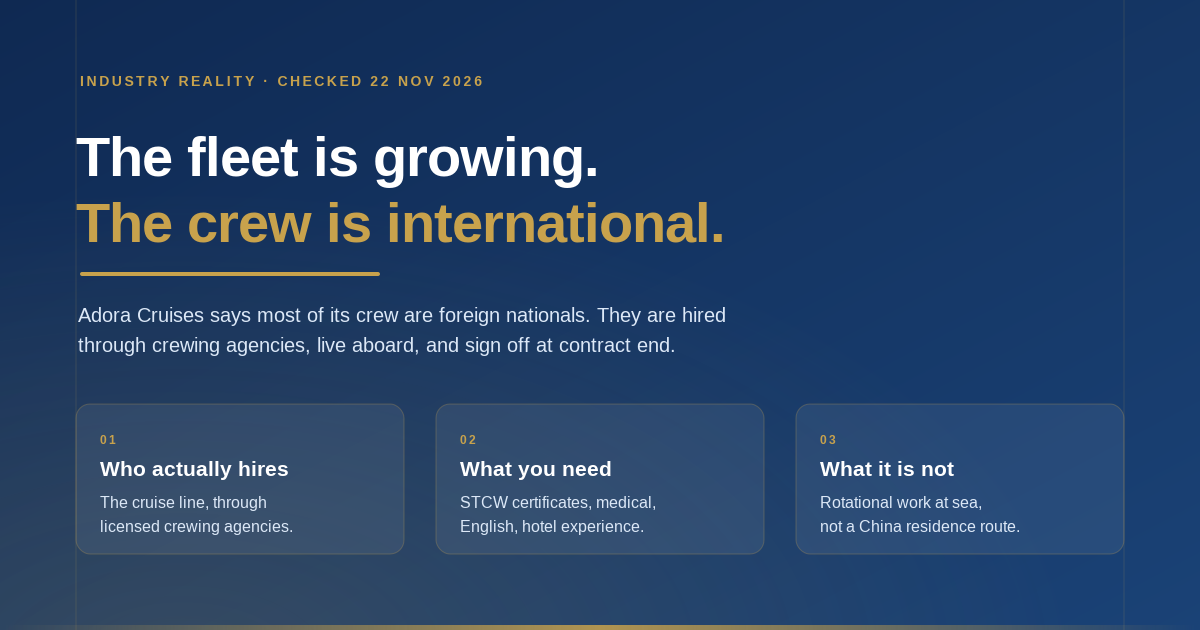
Cruise ships are one of the few workplaces in China where being foreign is ordinary. Close to 70% of the crew on Adora Cruises' two operating ships are foreign nationals, and the company is recruiting more than 1,500 people for its third ship. The catch is the shape of the job: you are hired through a crewing agency, you live aboard, and the contract ends.
This is what the company and its own recruitment materials say, checked on 22 November 2026. Where a figure comes from a press interview rather than a recruitment page, the source is named at the bottom.
Why this sector is different
A cruise ship is a workplace that travels. The crew is assembled from many countries because the ship sells an international product, and the working language is English rather than Mandarin. That is why this industry does not ask the question that closes most other doors in China — "can you already work here?" — in the same way.
Adora Cruises, the Shanghai-based brand operating Adora Magic City and Adora Mediterranea, states that its two ships carry more than 2,100 crew from over 30 countries, with close to 70% of them foreign nationals. It has said it will hire more than 1,500 additional staff for Adora Flora City, the second China-built large cruise ship, which was scheduled to enter service from Guangzhou Nansha in November 2026.
Who hires, and through whom
The company's own recruitment announcement is explicit that it works with international and domestic professional crewing agencies rather than hiring every seafarer directly. When Adora launched its global recruitment drive it named roles across marine operations, hotel management, food and beverage, housekeeping, onboard entertainment, shore excursions, marketing, retail, IT and HR, and published a single official mailbox for applications.
That structure is normal in shipping and is not a red flag by itself: manning agencies are paid by the shipowner, not by the seafarer. It becomes a red flag the moment an agency asks you for a placement fee, a deposit to hold a slot, or a training package you must buy before an interview. Our rule applies here too: never pay for a job.
What you need before anyone will talk to you
Two of these are legal requirements rather than employer preferences, and no agency can waive them.
| Requirement | Why it exists | Who checks it |
|---|---|---|
| STCW basic safety training | Mandatory under the international convention on standards of training, certification and watchkeeping for seafarers. | The flag state and the ship's safety management system. |
| Seafarer's documents and a valid medical | You cannot be signed on without identity documents, sea service records and a fitness certificate. | The crewing agency and the port authority. |
| Spoken English | The working language on board, and the language of the safety drills you must understand. | The interview, which is conducted in English. |
| Hotel or restaurant experience | Hospitality roles at sea are service roles; the ship is not a training hotel. | The hiring manager for the department. |
Recruitment advertising for these ships also states an age floor of 21, a health requirement and a limit on visible tattoos. Those are employer conditions rather than law, and they vary by department — but they are applied at interview, so they are worth knowing before you travel to one.
What this job is not
- It is not a Chinese work permit. You join a vessel under a seafarer's contract. Your workplace is the ship and your residence is your cabin; the contract ends and you sign off. This does not accumulate residence time toward a Chinese permanent residence permit, and it is a different immigration route from a land-based job.
- It is not a way to learn Chinese. The working language on board is English. You will hear Mandarin from passengers, but the job will not make you employable in a Mandarin office.
- It is not a stepping stone to a hotel job in China. Cruise experience is respected in the hotel industry, but the moment you apply on land you are back inside the local labour market, with the permit question attached.
Is it worth doing?
The offer is a package rather than a salary: accommodation and meals on board, a rotational contract, and an international record that is hard to obtain any other way early in a hospitality career. We have not published pay figures, because the numbers circulating online come from crewing agencies rather than from the employer, and an agency's quoted range is not a commitment.
The honest summary: a good first international job, and a poor immigration plan.
Common mistakes
- Paying for a placement. Legitimate manning agencies are paid by the shipowner. An upfront fee is the most common scam in this sector.
- Booking a flight before the certificate. Without STCW training you cannot be signed on, whatever the interview outcome.
- Assuming the contract renews on your terms. Rotations follow manning needs; the ship's schedule, not your preference, decides when you return.
- Confusing a cruise contract with China work experience. It is sea service. It counts at sea, and it does not count toward a work permit ashore.
What to do next
- Decide which department you are applying into: hotel services, food and beverage, entertainment, or technical. The requirements differ, and so does the pay.
- Complete STCW basic safety training and obtain the medical certificate before you approach any agency.
- Apply through the cruise line's own channel, or through an agency that can name the shipowner it recruits for, and confirm in writing who pays the agency.
- Read what Chinese law says about paid job placement before you sign anything.
Other sectors, same question
Each was checked the same way: official recruitment pages, and the rule that governs the sector.
- Can Tourism or Hospitality Get You a China Work Visa? — Hotels and local agencies hire locally. Three narrow openings remain.
- Flying in China on a Foreign Licence: What the CAAC Requires — The CAAC recognises foreign licences on nine published conditions.
- NGO Jobs in China: The Four Posts the Law Actually Names — One chief representative and up to three representatives per office.
- Exhibitions in China: Bilingual Work, Not Foreign Work — The business sells in English and operates in Mandarin.
- Coaching in China: The Visa a Coach Actually Needs — The sports M visa covers a trial, not a coaching season.
- Hotel Groups in China: The Door Is a Transfer, Not a Vacancy — Leadership is filled internally; the graduate route is closed.
- Treating Patients in China: The Licence Nobody Mentions — A one-year practice registration instead of a Chinese licence.
- Selling Abroad from China: The Sector Cities Recruit For — Cities recommend foreign livestream talent for work permits.
- Designing in China: Why the Stamp Is Not Yours — Design is international; the statutory stamp is not.
- Chambers of Commerce: A Channel, Not a Visa — A lead list of member employers, not a sponsor.
This article is general guidance based on the rules in force at the date above, not legal or immigration advice. Requirements and local practice change; confirm your own case with the competent authority or a qualified professional.
Sources
- Adora Cruises — announcement of its global seafarer recruitment programme — 3,000 crew positions, recruitment through international and domestic crewing agencies, and the official application mailbox.
- Nanfeng Chuang — Adora Flora City product and maiden-season routes — company interview stating 2,100-plus crew from over 30 countries, close to 70% foreign, and more than 1,500 additional hires.
- Yangcheng Evening News — the two home-built cruise ships at sea together — the same crew figures, reported at the start of Flora City's sea trials.
- Adora Cruises — official site — the fleet, the home ports and the current sailing programme.
Official pages, checked 22 November 2026. Requirements change without notice; the linked page prevails over this summary.
Related reading: Work visa overview · Salary & tax · All insights.