Coaching is one of the few sectors in China where a foreigner is an ordinary hire. It is also the sector where the wrong visa is most common: coaches work a whole season on a visa that was issued for a 90-day trial.
The rules below come from the 2014 notice jointly issued by the Ministry of Human Resources and Social Security, the Ministry of Foreign Affairs, the Ministry of Public Security and the Ministry of Culture on short-term work, checked on 22 November 2026. The hiring examples are postings we could read in full, and they are labelled as job-board listings rather than employer pages.
What the rules actually say
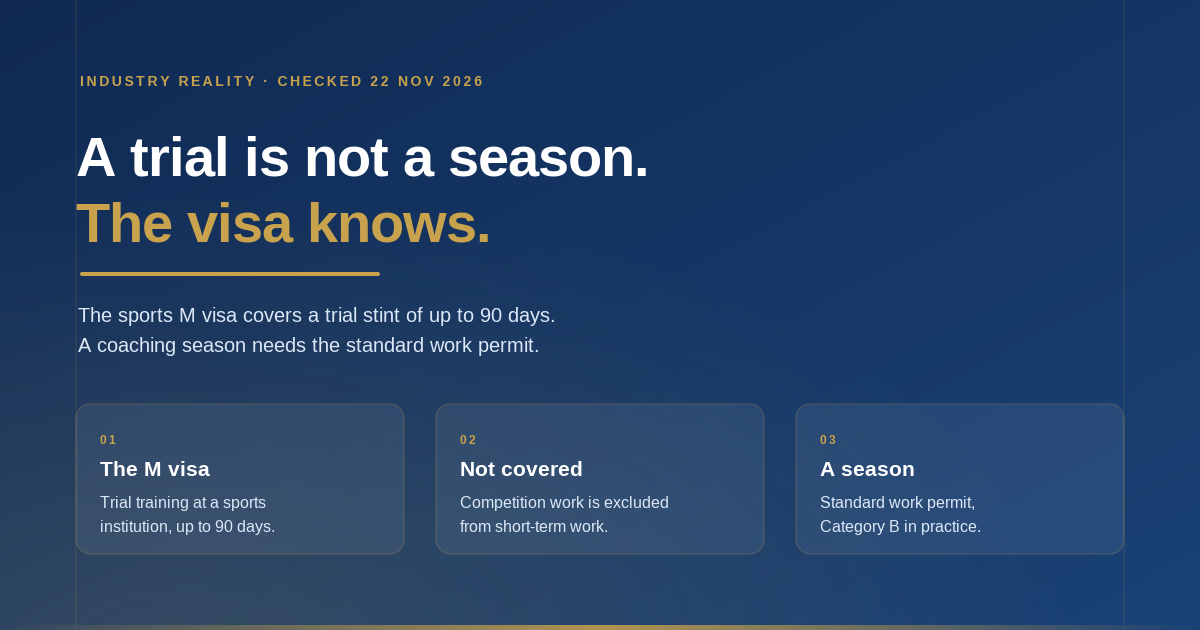
Short-term work means entering China for one of a fixed list of purposes for no more than 90 days. The list includes, in the official wording, going to a sports institution in China for trial training, including coaches and athletes. That purpose is served by an M visa.
The same notice then sets out what is not short-term work, and the fourth exclusion is the one coaches miss: taking part in a sports competition, including athletes, coaches, team doctors and assistants. Competition is not treated as work at all; it has its own entry route, and the M visa is not a substitute for it.
Finally, the notice states the boundary: anyone in these categories staying more than 90 days must go through the standard employment procedures for foreigners working in China. That means a work permit, not a visa category.
Three consequences for a coach
- An M visa is not a coaching job. It covers a trial or training stint at a sports institution for up to 90 days. A season-long academy or club contract is a different instrument.
- Competition work is excluded outright. If you are coming to compete, or to support a team at an event, the M visa is the wrong route and the short-term work procedure does not apply.
- Side clinics are not covered. A work permit ties you to one employer. Weekend clinics paid in cash alongside a school job are outside it, whoever arranged them.
Who hires, and what they check
| Employer type | What they check first | Permit route |
|---|---|---|
| International and bilingual schools | A teaching qualification or licence, plus the sport | Standard work permit; schools sponsor routinely. |
| Private training centres | A coaching badge and a degree; availability at evenings and weekends | Standard work permit, if the centre itself can sponsor. |
| Club academies with a foreign brand | A UEFA or national federation badge, youth-coaching experience, sometimes a specific language | Standard work permit; the club or its Chinese partner employs you. |
| Regional and national academies | Higher badges and several years of academy experience | Fixed-term contract with the institution, usually including flights. |
One posting we read, for a goalkeeping coach at one of the regional academies established by the Chinese Football Federation, asked for a UEFA or AFC goalkeeper B licence, more than five years of youth-academy coaching, a degree and English, on a two-year contract with one return flight a year. That is the top of this market, and it is filled through specialist football recruitment boards rather than through a Chinese job site.
The credential that decides your category
Coaching roles normally fall into Category B of the foreigner work permit classification, which expects a bachelor's degree or higher plus a professional qualification relevant to the job. In practice that means the badge is not a nice extra: it is what lets the employer file. A strong playing career without a coaching licence is the most common reason a club cannot complete the paperwork.
For school roles the calculation changes. Schools are buying a teacher who can also coach, so a teaching licence moves you into a different band than any coaching badge, and the timetable is term-time rather than evenings.
What this means for your job search
- Get the licence before you apply. A national federation certificate is the single item that turns a conversation into a permit application.
- Lead with qualifications and safeguarding, not your playing history. Most applicants reverse that order.
- Check who the employer of record is. Academies are often run by a Chinese partner company; the entity that signs the contract is the entity that must hold the permit.
- Ask how camps are paid. Summer and winter camps concentrate a coach's annual income, and "included in salary" is a different job from "paid separately".
Common mistakes
- Coaching a season on an M visa. It is the most common violation in this sector, and the penalty falls on the coach as well as the employer.
- Paying an agent for placement. Recruiters are paid by employers; see why we tell people never to pay for a job.
- Assuming a playing career substitutes for a licence. The permit authority, not the club, decides what counts.
- Taking cash side work. A permit names one employer; a Saturday clinic is not automatically covered by it.
What to do next
- Decide which employer type you are targeting — school, centre or academy — because the credential each one checks is different.
- Complete the coaching licence and keep the certificate ready in English, with a degree certificate alongside it.
- Ask any employer, before interview, whether it holds the permit itself or works through a partner company.
- Read the category guide and the visa sequence so the paperwork does not surprise you after you accept.
Other sectors, same question
Each was checked the same way: official recruitment pages, and the rule that governs the sector.
- Can Tourism or Hospitality Get You a China Work Visa? — Hotels and local agencies hire locally. Three narrow openings remain.
- Flying in China on a Foreign Licence: What the CAAC Requires — The CAAC recognises foreign licences on nine published conditions.
- Working on a China-Based Cruise Ship: Who Hires Foreign Crew — Foreign crew, hired through crewing agencies, on rotational contracts.
- NGO Jobs in China: The Four Posts the Law Actually Names — One chief representative and up to three representatives per office.
- Exhibitions in China: Bilingual Work, Not Foreign Work — The business sells in English and operates in Mandarin.
- Hotel Groups in China: The Door Is a Transfer, Not a Vacancy — Leadership is filled internally; the graduate route is closed.
- Treating Patients in China: The Licence Nobody Mentions — A one-year practice registration instead of a Chinese licence.
- Selling Abroad from China: The Sector Cities Recruit For — Cities recommend foreign livestream talent for work permits.
- Designing in China: Why the Stamp Is Not Yours — Design is international; the statutory stamp is not.
- Chambers of Commerce: A Channel, Not a Visa — A lead list of member employers, not a sponsor.
This article is general guidance based on the rules in force at the date above, not legal or immigration advice. Requirements and local practice change; confirm your own case with the competent authority or a qualified professional.
Sources
- MOHRSS, MFA, MPS and Ministry of Culture — procedures for foreigners entering China to perform short-term work (2014, trial) — the definition of short-term work including trial training at sports institutions, the exclusion of competition work, the M and F visa split, and the 90-day boundary.
- Chinese consulate — same notice, consular copy — a second official copy of the wording quoted above.
- Futboljobs — goalkeeping coach, regional academy — a job-board posting listing the licence, experience, contract and flight terms quoted in the article.
- JobsCina — football coach, La Liga-branded academy in Chengdu — a posting stating that the employer supports the Chinese work visa application.
Official pages, checked 22 November 2026. Requirements change without notice; the linked page prevails over this summary.
Related reading: Work visa overview · Salary & tax · All insights.