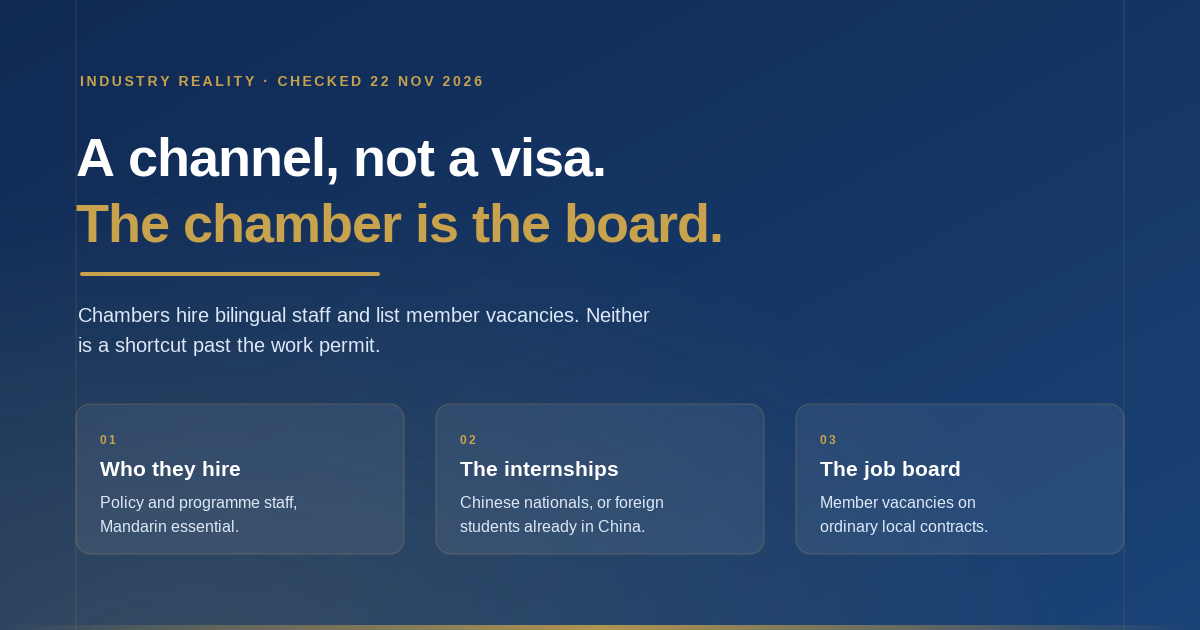
Chambers of commerce look like a shortcut into China: English-speaking, international, full of member companies. Structurally they are not. They are associations that hire locally, publish member vacancies, and run internship programmes restricted to people who are already allowed to be here.
The details below come from the chambers' own job boards and recruitment documents, checked on 22 November 2026.
What a chamber actually is
A chamber of commerce is an association of member companies. It is not a diplomatic mission and it is not an employment agency. Its own staff are locally employed professionals, and the permit they hold is the ordinary foreigner work permit sponsored by the chamber as an employer — the same instrument any other company would use.
That matters because it sets the ceiling on what a chamber can do for you. It can hire you, if you fit a vacancy. It cannot sponsor you into a member company, and it has no special immigration channel to offer.
Who they hire
Chamber vacancies cluster in policy, government affairs, programme management and events. The language requirement is not decorative. A trade and investment associate posting at AmCham Shanghai asks for bilingual Mandarin and English skills, with proper Chinese language skills particularly in local government settings, plus a degree in international relations, political science, economics, business or communications and two to four years of experience.
A programme manager role at AmCham China, running an aviation cooperation programme, states plainly that communication is conducted in both English and Chinese and that some translation work is required. These are jobs for people who can operate in a Chinese institutional environment, not English-speaking figureheads.
The internship door, and who it excludes
The internship programmes are the most misunderstood part. AmCham China's published eligibility is explicit on two points: applicants must currently be enrolled students, and graduates are not eligible at all. The positions are open to Chinese nationals and to expatriate students studying in China on an X1 or X2 visa.
Read that carefully. If you are a foreign student already in China, an internship is a genuine route into the network. If you are a professional abroad, the door is closed — not because of a language test, but because the programme is built for people already inside the country on a student status.
The job board
Both chambers run member job boards. They are exactly what they sound like: a curated list of vacancies at member companies, each with the company's own application contact. Roles range from consultancy and recruitment to hospitality and industrial sales, and they are ordinary local hires on local contracts.
That is still useful. A chamber board is a concentrated list of employers who already operate with foreign staff and are comfortable with English-language CVs, which saves you weeks of filtering. What it is not is a placement service: you apply to the company, and the company sponsors the permit.
What this means for your job search
- Treat the board as a lead list, not a job. The value is the employer list, not the chamber's endorsement.
- If you are a student in China, the internship route is real, and it is one of the few structured ways to meet dozens of member companies in a few months.
- If you are applying from abroad, target the member companies directly. The chamber itself hires a handful of people a year, with Mandarin as a hard requirement.
- Expect a bilingual interview. Even English-first chambers test your Chinese if the role touches government, members or events.
Common mistakes
- Assuming a chamber is an employer of foreigners. It employs a small bilingual team; the members employ everyone else.
- Applying to internships as a graduate. The eligibility line excludes anyone who is not currently enrolled.
- Paying for membership to find work. Chamber membership is sold to companies, and it is not a job placement product — see why we tell people never to pay for a job.
- Confusing the chamber with the embassy. Visas, notarisation and consular matters belong to the embassy; the chamber does not touch them.
What to do next
- Open the chamber job board in the city you are targeting, and copy the member companies into your own target list.
- Apply to those companies directly, and mention the sector community only as context, not as a referral.
- If you are a student, check the internship eligibility before you write, and apply while your enrolment is current.
- Read the permit categories so you know which category the role is likely to fall into.
Other sectors, same question
Each was checked the same way: official recruitment pages, and the rule that governs the sector.
- Can Tourism or Hospitality Get You a China Work Visa? — Hotels and local agencies hire locally. Three narrow openings remain.
- Flying in China on a Foreign Licence: What the CAAC Requires — The CAAC recognises foreign licences on nine published conditions.
- Working on a China-Based Cruise Ship: Who Hires Foreign Crew — Foreign crew, hired through crewing agencies, on rotational contracts.
- NGO Jobs in China: The Four Posts the Law Actually Names — One chief representative and up to three representatives per office.
- Exhibitions in China: Bilingual Work, Not Foreign Work — The business sells in English and operates in Mandarin.
- Coaching in China: The Visa a Coach Actually Needs — The sports M visa covers a trial, not a coaching season.
- Hotel Groups in China: The Door Is a Transfer, Not a Vacancy — Leadership is filled internally; the graduate route is closed.
- Treating Patients in China: The Licence Nobody Mentions — A one-year practice registration instead of a Chinese licence.
- Selling Abroad from China: The Sector Cities Recruit For — Cities recommend foreign livestream talent for work permits.
- Designing in China: Why the Stamp Is Not Yours — Design is international; the statutory stamp is not.
This article is general guidance based on the rules in force at the date above, not legal or immigration advice. Requirements and local practice change; confirm your own case with the competent authority or a qualified professional.
Sources
- AmCham Shanghai — job board — the member-company vacancies and the direct application contacts published for each role.
- AmCham Shanghai — associate, Trade and Investment Center (PDF) — the bilingual Mandarin and English requirement, the degree fields and the experience range.
- AmCham China — careers and internship listings — the internship eligibility wording: current students only, Chinese nationals and expatriate students on X1 or X2 visas.
Official pages, checked 22 November 2026. Requirements change without notice; the linked page prevails over this summary.
Related reading: Work visa overview · Salary & tax · All insights.