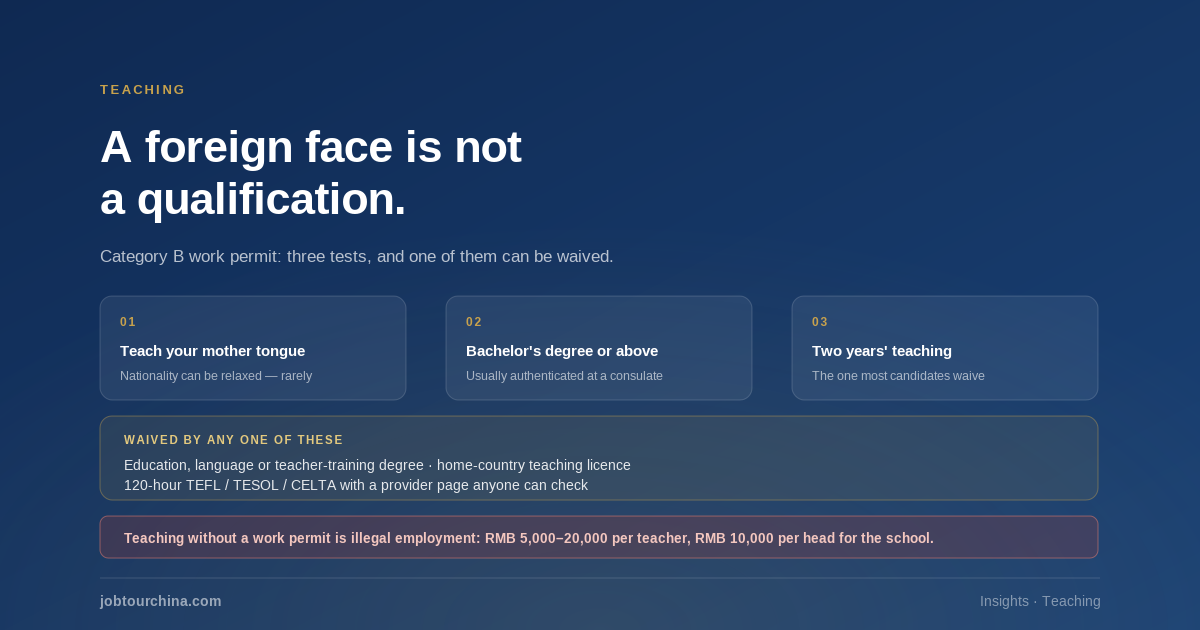
To teach English legally in China you need three things: a bachelor's degree, two years of language-teaching experience (or a recognised substitute for it), and an employer that files a work permit in your name. Nothing else gets you over the line — not a native passport, not a certificate on its own, not a school's assurance that "everyone works this way here".
That is worth stating plainly, because the market has spent two decades pretending otherwise. Teaching on a tourist visa or a student visa is illegal employment, and in every documented case the penalty lands on both the teacher and the school.
The rule that actually applies
The document most often quoted at applicants, the Measures for the Appointment and Management of Foreign Teachers, is still a consultation draft published in July 2020. It is not in force. The instrument that decides your file is the 2017 Classification Standard for Foreigners Working in China, which places foreign language teachers in Category B — professional talent — under three conditions:
- teach your mother tongue, in principle;
- hold a bachelor's degree or above;
- have at least two years of language-teaching experience.
Everything else is detail layered on top of those three lines.
The experience waiver is the whole game
The third condition removes most candidates from the pool — and it is the one with a well-defined escape route. Any single item below cancels the two-year requirement:
- a bachelor's degree or higher in education, language or teacher training;
- a teaching licence from your home country;
- a qualifying international language teaching certificate.
"Qualifying" is defined far more tightly than most course sellers admit. It means one of three things: the TEFL in China certificate issued by the foreign talent information research centre; a course of 120 hours or more covering classroom management, lesson planning, grammar, lexicology and phonology, with a provider web page the case officer can actually open; or a certificate from a foreign university that appears on the Ministry of Education's list of recognised overseas institutions. A PDF plus a QR code from a website that no longer resolves fails the last test — and this is checked, not assumed.
Non-native speakers are not automatically excluded. The nationality requirement is relaxed for someone holding a doctorate, or a master's in education, language or teacher training, earned in a country where the language being taught is native — or a teaching licence issued there. The degree itself must be authenticated.
The employer test almost every candidate skips
A lot of advice online says the school must hold a "foreign expert hiring qualification". That licence was abolished in 2016 by State Council Decision Guofa [2016] No. 10. Asking whether a school has one is now the wrong question, and a confident "yes" is a sign the school has not updated its own paperwork since 2015.
The useful questions are duller:
- Is it a legal entity holding the sector licence its business actually needs — a private school permit for a school, a business licence covering non-degree training for a training centre?
- Has it filed a work permit before? A first-timer will learn the process on your file.
- Will the position on the permit describe what you will really do — "English teacher", not "education consultant"?
Scope is where this bites. A permit names an employer and a position. Teaching at a second campus, or covering a Saturday at a partner centre, is working beyond the scope of your permit and falls inside the statutory definition of illegal employment (Article 43). A teacher in Xinji held a valid permit and was still penalised for teaching at another branch of the same organisation.
What non-compliance costs
| Conduct | Foreign national | Employer |
|---|---|---|
| Illegal employment — no permit, or work outside it | RMB 5,000–20,000; detention of 5–15 days in serious cases | RMB 10,000 per person, capped at RMB 100,000; illegal gains confiscated |
| Overstaying | RMB 500 per day, capped at RMB 10,000, or detention of 5–15 days | — |
Both figures come from Articles 78 and 80 of the Exit and Entry Administration Law. The fine is rarely the worst part: an illegal-employment record surfaces at the next visa application and can end with the visa cancelled and a period of exclusion attached.
The process, end to end
- The school files online and obtains a Notification of Foreigner's Work Permit.
- You apply for a Z visa at a Chinese embassy or consulate abroad, using that notification.
- Within 30 days of entry, you complete the work permit, then the work-type residence permit.
- Employer, position and permit must agree. Changing employer means a fresh approval — not a letter, not an internal transfer.
Expect consular authentication of the degree, a criminal record certificate issued recently (most cities want it within six months) and a medical check. Enforcement tightens in Beijing, Shanghai, Guangzhou and Shenzhen and loosens where teachers are scarce. A few provinces have moved further: Shandong exempts PhD holders from the native-language-country rule and allows non-native English majors with a bachelor's degree to apply after an official language assessment. Treat every variation as local, current, and worth confirming at the window rather than on a forum.
Which employer you choose changes the paperwork
Three types of employer dominate the market, and they screen differently. International schools hire against a teaching licence and subject experience, because their accreditation expects it — the work permit is the last step, not the first. Public schools and universities usually run through a provincial foreign expert channel, are slower, and often prefer candidates already inside China. Private training centres move fastest and are where the waiver document does the most work, but they are also where the "just come and we will sort the visa" offer comes from, and where the 2016 abolition of the hiring licence left the least institutional memory.
The pattern is consistent: the more established the institution, the earlier the permit conversation happens. If a school first mentions visas after you have accepted, that is your signal.
If you are the school
Three habits prevent nearly all of this. Collect the degree, the criminal record check and the waiver document before making the offer, not after. File the permit before the teacher books a flight. And write the position on the application exactly as you would describe it to an inspector, because that is the version that will be read back to you if anything is ever disputed.
What to do next
- Work out which of the three waiver routes you can document today, and in what form.
- Ask the school for the exact job title it will put on the permit, in writing.
- Check authentication requirements at the specific consulate you will use — they differ by post.
- Do not start teaching, paid or unpaid, before the residence permit is in your passport.
This article is general guidance based on published rules at the date above, not legal or immigration advice. Requirements and local enforcement vary by city and change without much notice; confirm your own case with the local science and technology (foreign expert) authority or a qualified professional.
Related reading: Work permit categories A, B and C · Outsourcing, dispatch and contracting · Work visa overview · All insights.
Sources
- Exit and Entry Administration Law of the People's Republic of China — National Immigration Administration, official English text. Article 41: work permit and work-type residence permit required before any work begins.
Official text, checked 18 November 2026. Quoted for reference only; the Chinese original prevails.