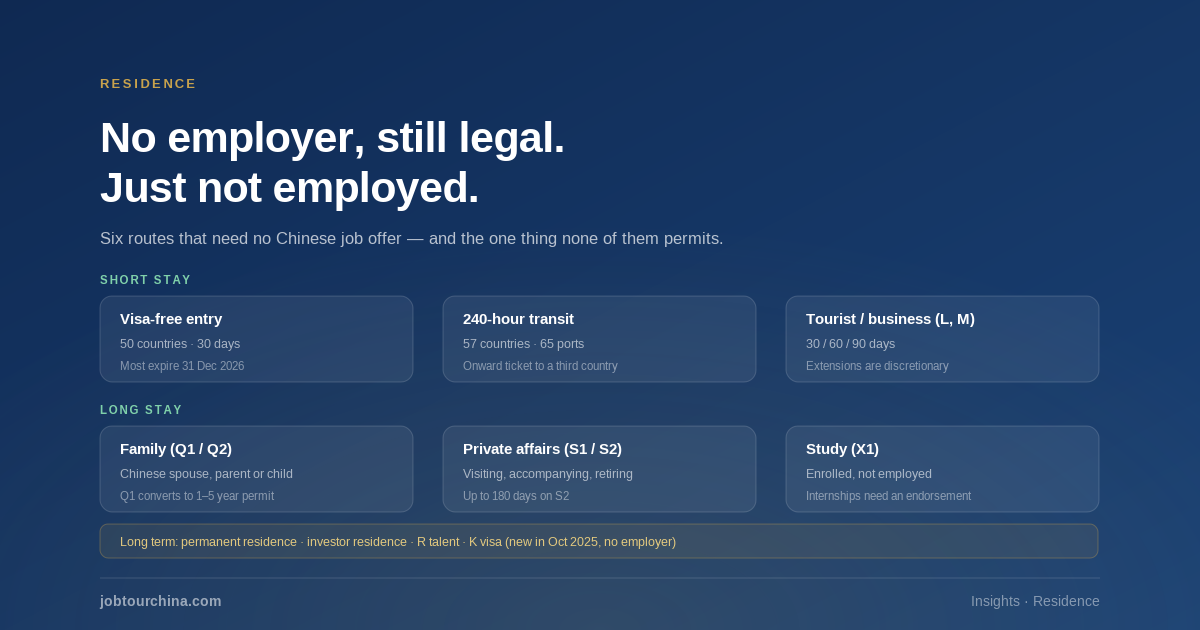
Yes — there are several ways to live in China legally without a Chinese employer, and one of them, the K visa introduced in October 2025, was designed specifically for people who arrive with no job offer at all. But each route is a residence route, not a work route, and the distinction is where most of the expensive mistakes happen.
One rule sits above everything below: staying in China without an employer does not give you the right to work in China. Paid work needs a work permit and a work-type residence permit, and short-term status — visa-free entry, a tourist visa, an S2 private affairs visa — prohibits it outright.
The routes, compared
| Route | Typical stay | Who it fits | Paid work? |
|---|---|---|---|
| Visa-free entry (50 countries) | 30 days | Tourism, family visits, business talks, transit | No |
| 240-hour transit | 10 days | Passing through to a third country | No |
| L / M visa | 30, 60 or 90 days | Tourism; commercial visits | No |
| Q1 / Q2 family | Up to 180 days; Q1 becomes a 1–5 year permit | Spouse, parent, child or sibling of a Chinese citizen or foreign permanent resident | No |
| S1 / S2 private affairs | Up to 180 days; S1 becomes a residence permit | Visiting or accompanying relatives, retirement, long stays | No |
| X1 study | Course length, via study residence permit | Enrolled students | No, beyond permitted work-study |
| K visa | Longer entry validity and stay than other short-stay categories | Young STEM graduates and researchers, no employer needed | No — exchange, start-ups and business only |
Short stay: visa-free, transit, tourist
China's unilateral visa-free scheme currently covers 50 countries (the Ministry of Foreign Affairs list, updated February 2026), with a maximum stay of 30 days for tourism, family visits, business exchange and transit. Most of these arrangements expire on 31 December 2026; Russia's runs to 31 December 2027 and Brunei's has no expiry date. Two practical details people get wrong: the 30 days are counted from midnight on the day after entry, and the scheme does not cover work, study or journalism.
The 240-hour transit exemption covers 57 countries across 65 ports and allows 10 days, on condition that you hold a connecting ticket to a third country. It is a transit facility. Turning it into a stay — changing your purpose, or simply not leaving — is exactly the overstay the scheme is designed to catch.
An L tourist visa gives 30, 60 or 90 days, with multiple-entry versions available. Extensions inside China are reviewed on their merits and are not automatic. An M business visa covers commercial visits — meetings, negotiation, inspection — not employment, and the distinction between "advising a client" and "being paid by a client" is the one that matters.
Family and private affairs
Q1 and Q2 exist for the immediate family of Chinese citizens and of foreign permanent residents: spouses, parents, children, and in some categories siblings, grandparents and grandchildren. Q1 is for stays over 180 days and converts into a residence permit, usually valid for one to five years. Q2 covers up to 180 days per entry. Both need an invitation letter and documentary proof of the relationship — a marriage certificate or birth certificate, usually authenticated.
S1 and S2 cover private affairs that are not family reunion: visiting a relative who works or studies in China, accompanying a student, retirement, or a long personal stay. S1 converts to a residence permit; S2 is capped at 180 days. The file typically needs kinship documents, a supporting letter from the relative in China and evidence of financial support. S2 is also the visa Shanghai uses, with an "internship" annotation, for overseas students doing a short placement — a separate scheme with its own rules.
Study: X1
An X1 visa is issued against an admission letter and a JW201 or JW202 form, and must be converted into a study residence permit within 30 days of entry, with a medical check and local medical insurance. Students may take part in work-study and off-campus internships only within the permitted scope, and an off-campus internship needs an endorsement added to the residence permit first. Doing it without that annotation puts both the student and the host organisation in the penalty zone.
Long stay without a job
- Investor residence. For people who make a direct investment in China, with the investment stable for three consecutive years and above the applicable threshold. You reside as an investor, not as an employee, and are not on a payroll.
- Permanent residence. The "green card" runs on four tracks — spousal reunion, senior-level employment, substantial investment, and special contribution or skills in urgent national demand. Each has its own residence-years, income and qualification thresholds. It is granted for a long or indefinite period and lifts the annual renewal cycle.
- R visa. For high-level talent and urgently needed specialists. It is a talent channel rather than an employment relationship, but it generally requires a Chinese host institution or project.
- K visa. New from 1 October 2025, created by State Council Order No. 814. It is issued to young foreign science and technology talent who hold a bachelor's degree or above in a STEM field from a recognised university or research institution, or who teach or research at one. The point of it is that no Chinese employer or inviting entity is required, and it offers more favourable terms on entries, validity and duration than the existing categories. Holders may engage in exchange in education, science, technology and culture, and in start-ups and business activity.
The K visa is the most widely misread of the four. It removes the employer requirement for entering and staying. It does not create a right to be employed: a salary from a Chinese entity still requires a work permit. People who assume otherwise discover the difference at the point where they accept an offer.
Digital nomads: no dedicated visa exists
China has not created a digital nomad visa. Remote workers typically enter on an M business visa or an L tourist visa and work for an overseas employer, with income paid abroad. In practice, working remotely for a foreign employer, with no Chinese salary and no labour relationship with a Chinese entity, is generally not treated as employment. That is a description of how it is handled, not a written authorisation: there is no published rule permitting it, and enforcement varies by city. Anyone building a long-term plan on that footing should know they are standing on practice, not law.
What it costs when it goes wrong
Overstaying carries a fine of RMB 500 per day, capped at RMB 10,000, or detention of 5 to 15 days (Article 78). Illegal employment carries RMB 5,000–20,000 for the individual and detention in serious cases, plus RMB 10,000 per person for the employer, capped at RMB 100,000, with illegal gains confiscated (Article 80). Both can be followed by cancellation of the visa, deportation and an entry ban — which is the part that affects the next five years of your career, not just this trip.
Choosing the right route
Work backwards from what you will actually be doing, not from which visa is easiest to obtain:
- Any Chinese entity pays you — salary, retainer, consultancy fee — and you need a Z visa and a work permit. There is no exception for short assignments or "trial periods".
- You are joining family — Q1, or S1 if the relationship is outside the immediate-family list.
- You are studying — X1, and add the internship endorsement before you start any placement.
- You are researching, founding or exploring — K if you meet the STEM profile, M for commercial visits.
- You are retiring or living on foreign income — S1/S2, with the financial-support evidence the post asks for.
This article is general guidance based on published rules at the date above, not legal or immigration advice. Visa-free arrangements, city-level practice and processing standards change frequently; confirm your own case with the exit-entry administration or the Chinese embassy or consulate you will apply through.
Related reading: Stay vs residence: staying legal · Work permit categories · Hiring foreign interns · Work visa overview · All insights.
Sources
- Exit and Entry Administration Law of the People's Republic of China — National Immigration Administration, official English text. Articles 29, 30 and 34: stay periods, residence permits and stay permits.
Official text, checked 18 November 2026. Quoted for reference only; the Chinese original prevails.