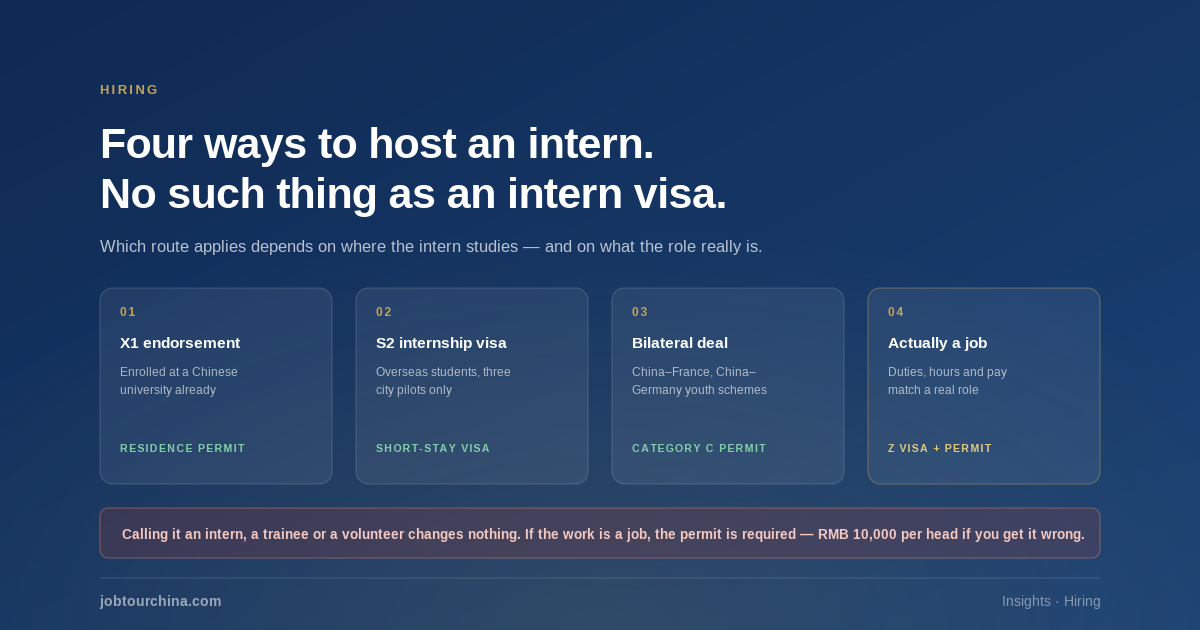
China has no national internship visa. For an HR team that sentence is not trivia — it means the paperwork you file depends on where the intern is enrolled, which city your entity sits in, and whether the role is genuinely an internship or a job with a different label on it. Get the route wrong and the exposure is RMB 10,000 per person, with a statutory cap of RMB 100,000 per case.
This is the employer-side map. For the student's view of the same rules — what to ask a host before accepting — read our guide for foreign students.
Start with the duties, not the title
Article 43 of the Exit and Entry Administration Law defines illegal employment to include working beyond the scope permitted. Nothing in that test refers to the job title. If the intern has set hours, a manager, deliverables and a monthly payment, the arrangement is employment however the contract is headed — and "intern", "trainee" and "volunteer" are all words that have failed to change the analysis in enforcement practice.
So the first HR decision is not which visa to use. It is whether the role is a placement (learning, supervised, time-limited round a study programme) or a headcount you are trying to fill cheaply. If it is the second, stop reading the pilot schemes and go to route four.
Route 1: students already in China on an X1 permit
A foreign student enrolled at a Chinese university holds a study residence permit. To take an off-campus internship or work-study job, Article 22 of the Regulations on the Administration of the Entry and Exit of Foreigners requires two things in sequence: written consent from the university, then an application to the exit-entry administration to add an endorsement to the residence permit stating the host organisation, the location and the period.
What that means in practice for the host:
- You need a letter on company letterhead naming the supervisor, the start and end dates, the location and the duties. A one-line "we confirm the internship" letter is routinely sent back.
- The university's international office must issue its own consent — you cannot substitute for it, and the student cannot start while it is pending.
- The endorsement is time-bound to the dates on it. Extending the internship means amending the endorsement, not issuing a new internal letter.
Without the endorsement, both sides are exposed. The student falls inside the definition of illegal employment; the host falls inside illegal hiring.
Route 2: students at overseas universities — three city pilots
Short-term placements for students enrolled abroad run on local pilot schemes. There is no national standard, and — this is the part that catches multinationals — the pilots do not travel. A file prepared to Shanghai's requirements and submitted in another city is rejected, and repeating the attempt does not improve the answer.
| Pilot | Who qualifies | Instrument | Ceiling |
|---|---|---|---|
| Shanghai | Overseas students invited by a Shanghai enterprise or public institution | S2 short-term private affairs visa annotated "internship" | 6 months; no conversion to employment during the placement |
| Beijing Zhongguancun | Overseas students invited by high-tech enterprises registered in Zhongguancun | S2 visa with the same annotation, filed through the Beijing Science and Technology Talent Development Centre (no fee) | University must appear on the Ministry of Education's supervision list |
| Shenzhen | Enterprises filed in the Guangdong Pilot Free Trade Zone; or holders of a study residence permit issued elsewhere | S2 applied for at the port visa office, or an endorsement added at the municipal exit-entry window | Stay permits are not eligible — it must be a residence permit |
Shanghai is the most used and the best documented. The inviting entity assembles the student's proof of enrolment, the internship agreement, a corporate guarantee letter and its own business licence, and lodges through the exit-entry administration with support at Pudong International Talent Port. Published processing time is around seven working days once the file is complete; assume the passport is held for that period and plan the start date backwards from it.
Zhongguancun is narrower but free and fast, and it only works for companies actually registered in the park. Shenzhen's second scenario is the useful one for groups: an intern already studying in another province can have the endorsement added locally, provided the underlying document is a residence permit rather than a stay permit. That distinction — residence permit yes, stay permit no — is the single most common reason a Shenzhen file is refused at the window.
Route 3: bilateral government programmes — a Category C work permit
Two schemes do not use the S2 or the residence-permit endorsement at all. The China–France 1,000 Interns Programme and the China–Germany Youth Internship Programme run under bilateral agreements and are filed as a Foreigner's Work Permit, Category C. For the China–France scheme the published conditions are: aged 18 to 30, a placement of 3 to 6 months, and at least two years of higher education completed.
The mistake here is procedural: HR teams see "internship" and reach for the S2 route, then discover the applicant's nationality routes them into a work-permit file that needs a different system, a different set of documents and a longer lead time. Check the nationality against the bilateral programme list before you choose the instrument.
Route 4: it is actually a job
Then it is a Z visa, a work permit and a work-type residence permit — the standard sequence described in our guide to categories A, B and C. The Category B threshold (a degree plus two years of relevant post-graduation experience, with limited waivers) is precisely why the "internship converts to a full-time offer" plan so often collapses at the permit stage: the internship does not close the experience gap that the permit requires.
If you intend to convert, plan it before the intern arrives. A student who finishes a six-month placement and then needs a Z visa has to leave and apply from abroad in most cases, which costs you the handover and a hiring cycle.
What getting it wrong costs
- Illegal hiring: RMB 10,000 per foreign national, capped at RMB 100,000, with illegal gains confiscated (Article 80).
- The intern: RMB 5,000–20,000, and detention of 5 to 15 days in serious cases.
- Introducing someone into illegal employment: RMB 5,000 per person, capped at RMB 50,000 for an individual and RMB 100,000 for an entity — which is the provision that reaches recruiters and agencies.
- Beyond the fine: a record that surfaces at the next application, and for the company, a compliance finding that will be raised by every subsequent counterparty doing due diligence.
HR checklist before day one
- Where is the intern enrolled — a Chinese university, or one abroad? That single answer eliminates half the routes.
- Does the role have set hours, a manager and a payment? If yes, treat it as employment and file accordingly.
- Is the host entity licensed for the activity it is hosting the intern in?
- Which city is the entity in, and does that city actually run a pilot? Confirm at the window, not from a group policy document.
- Is the underlying document a residence permit (eligible for endorsement) or a stay permit (not eligible)?
- Who at the university signs the consent, and how long does that take?
- If conversion to a permanent role is the plan, has the Z visa timeline been built into the hiring plan?
A host that can answer all seven before the intern books a flight is doing this properly. A host that answers "we will sort it out when they arrive" is asking the intern to carry a risk that belongs to the company.
This article is general guidance based on published rules at the date above, not legal or immigration advice. Internship pilots are local measures with their own eligibility criteria, they change, and counter-level practice can differ from the published text. Confirm with the relevant exit-entry authority before committing to a start date.
Related reading: Internships for foreign students · Work permit categories · Outsourcing and dispatch · For employers · All insights.
Sources
- Exit and Entry Administration Law of the People's Republic of China — National Immigration Administration, official English text. Articles 42 and 43: internship rules for foreign students and the three forms of illegal employment.
Official text, checked 18 November 2026. Quoted for reference only; the Chinese original prevails.