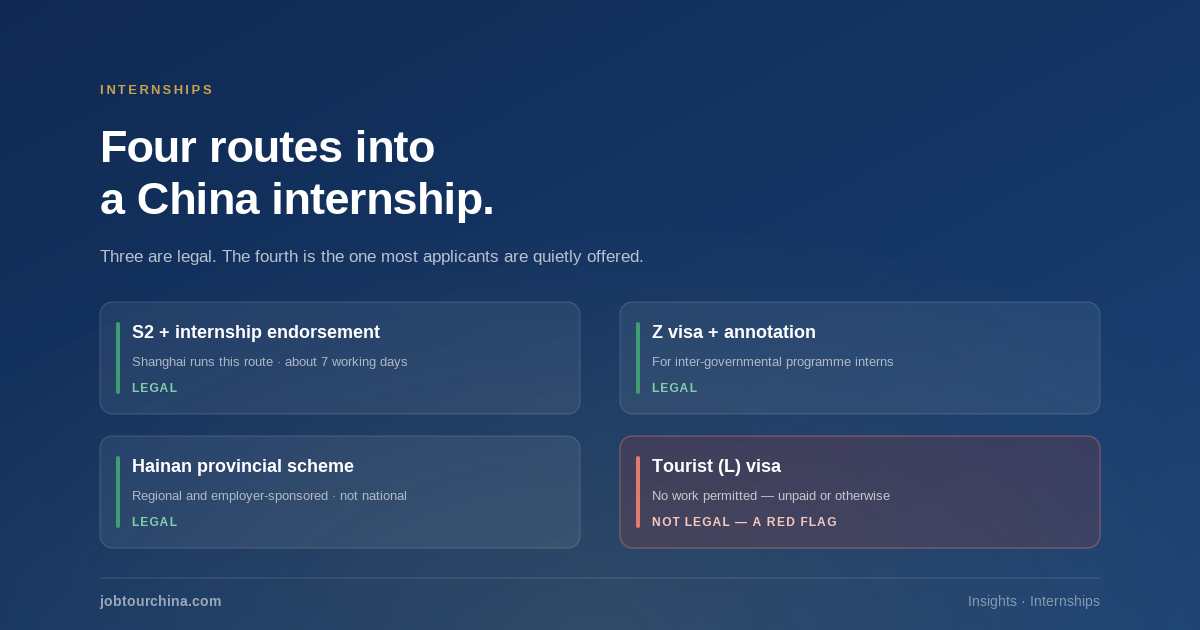
There is no national internship visa for China. That single fact explains most of the confusion foreign students hit when they try to arrange an internship here — and it is why the answer to "can I come and intern?" depends entirely on where the internship is and which local scheme the host is able to use.
Two cities have built workable routes: Shanghai and Hainan. They are local practices, not national rules, and a route that is routine in one city can be refused in another.
The four routes, compared
| Route | Who it fits | How you enter | Status while interning |
|---|---|---|---|
| Shanghai — S2 visa endorsed "internship" | Students enrolled at an overseas university, invited by a Shanghai enterprise or public institution | Short-stay entry, then apply for the S2 endorsement in Shanghai | Short-stay private affairs visa with an internship endorsement |
| Work-type residence permit endorsed "internship" | Overseas university students interning under inter-governmental agreements | Z visa | Work-type residence permit endorsed for the internship |
| Hainan local measures | Overseas students invited by qualified Hainan entities (enterprises, hospitals, international schools, hotels) | Port visa on arrival, or a switch after entry | Depends on the scheme — short stay, or residence under cooperation programmes |
| Tourist (L) visa | Nobody, for this purpose | — | Illegal — internship activity does not match a tourist visa |
Shanghai: the S2 route, in detail
Shanghai's published guidance allows an S2 (short-term private affairs) visa to be endorsed "internship" for foreign students enrolled at an overseas university who are invited to intern at a Shanghai enterprise or public institution. The application is handled by the Shanghai Public Security Bureau's exit-entry administration, with service support at Pudong International Talent Port.
Three documents carry the weight:
- Proof of enrolment at the overseas university — and the institution needs to be verifiable through the Ministry of Education's overseas education supervision website. If your university cannot be checked there, this is the first thing to resolve.
- An internship certificate and an internship activity plan issued by the inviting unit. Vague letters describing "cooperation" do not satisfy this; the plan should describe what you will actually do.
- The host entity's registration documents — business licence or equivalent registration certificate.
Published processing time is around seven working days once the file is complete, and applicants should expect their passport to be held for roughly that period. Plan travel around it.
The Z-visa route for agreement-based internships
There is a second, less-known path: students coming to intern under inter-governmental agreements enter on a Z visa and then obtain a work-type residence permit endorsed "internship". This is a different mechanism from the S2 endorsement — it produces a residence permit rather than a short-stay visa, and it requires the underlying work permit to carry the internship endorsement, plus the standard health certificate and host-entity documents.
If a host tells you they will "sponsor an internship", ask which of these two mechanisms they mean. They are not interchangeable, and the answer determines whether you arrive on a Z visa or a short-stay visa.
Hainan
Hainan has published its own measures for foreign students interning at qualified local entities, including the option of a port visa on arrival or a switch of status after entry, and additional residence options for graduates in innovation and entrepreneurship schemes. The eligibility conditions and the list of qualified hosts are set locally and change; treat any summary — including this one — as a pointer, and confirm with Hainan's exit-entry authorities or the host entity before booking travel.
Why "come on a tourist visa" is a trap
The most common bad advice given to students is to enter visa-free or on a tourist visa and "sort it out later". Two rules make that dangerous:
- Foreign nationals may not engage in activities inconsistent with the purpose of their stay or residence (Exit and Entry Administration Law, Article 37).
- Students who work beyond the scope permitted under the work-study rules fall within the statutory definition of illegal employment (Article 43).
Changing purpose after entry also carries its own review risk: border officers assess your declared purpose on arrival, and a later switch from "tourism" to "internship" invites exactly the inconsistency finding you are trying to avoid. If an internship is the plan, arrive with the right basis.
What to ask the host before you accept
- Which route will you use — Shanghai S2 endorsement, Z visa with an internship-endorsed work permit, or a Hainan scheme?
- Will you issue an internship certificate and an activity plan, on company letterhead, naming my supervisor?
- Can you provide your business licence or registration certificate for the visa file?
- Is the internship paid? If so, how is that structured — because payment changes the legal analysis.
- If the arrangement fails at the visa stage, what happens to the offer?
A host that has done this before will answer all five without hesitating. A host that has not will ask you to figure it out — which means you are the one carrying the compliance risk.
After the internship: the work-permit question
An internship authorisation is not a work authorisation. If you want to stay and work, you need an employer to sponsor a work permit and a work-type residence permit, and the standard professional category expects a degree plus relevant post-graduation experience. That requirement is precisely why fresh graduates often find the internship-to-employment step harder than expected — the internship itself does not close the experience gap. Our guide to categories A, B and C sets out what each route actually requires.
This article is general guidance based on published rules and local guidance at the date above, not legal or immigration advice. Shanghai and Hainan schemes are local practices with their own eligibility criteria and are subject to change; other cities may not offer equivalents. Confirm with the relevant exit-entry authority before making commitments.
Related reading: Stay vs residence: staying legal · Work permit categories · Work visa overview · All insights.
Sources
- Exit and Entry Administration Law of the People's Republic of China — National Immigration Administration, official English text. Articles 42 and 43: work-study rules for foreign students and what counts as illegal employment.
Official text, checked 18 November 2026. Quoted for reference only; the Chinese original prevails.