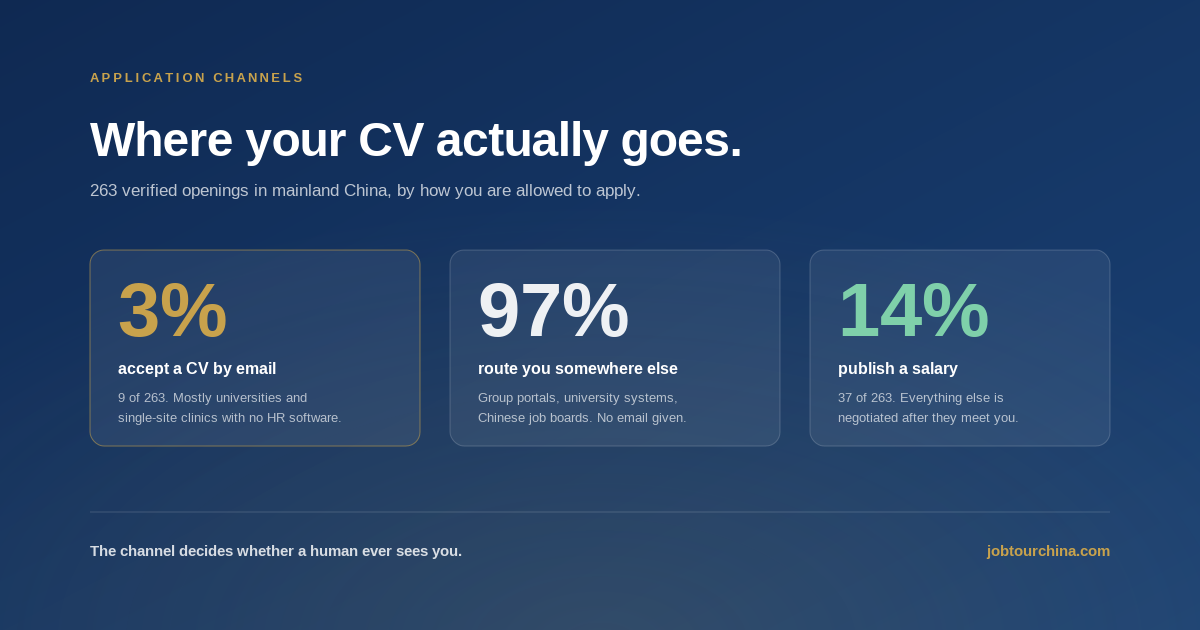
In China, the channel you apply through decides whether a human ever sees your CV. Most job ads never publish an email — they push you into a group recruitment portal, a university HR system, or a Chinese job platform. And when an employer does give an address, they usually also dictate the subject line, because that line is how they filter a few hundred messages a day.
This page covers the four things that actually determine whether you get a reply: which channel to use, how to title the message, who to contact, and what to attach.
Most openings do not accept email at all
We track 263 open roles in mainland China across international schools, public universities, embassies and international organisations, and private hospitals. Only 9 of them (3%) accept a CV by email. The rest send you somewhere else:
| Where the application actually goes | Share of the roles we track | What it means for you |
|---|---|---|
| A group recruitment portal (Avature, Workday, SuccessFactors) | Roughly half | One profile covers every school or hospital in that group — worth building properly once |
| The institution's own application system | About a third | Usually Chinese-language forms; some require a Chinese mobile number |
| A Chinese job board (BOSS Zhipin, Zhaopin, 51job) | Small but growing | Real-name registration and a Chinese phone number are normally required |
| 3% | Only where the ad explicitly prints an address |
The practical consequence: if your entire strategy is "find the email and send a CV", you are competing for 3% of the market. The other 97% never sees you.
Where the email route is still normal
Email survives in three niches, and it is worth knowing them because they are exactly the niches where individual foreign applicants have an advantage:
- University foreign-teacher posts. A language college advertising for native speakers usually prints a mailbox and nothing else. There is no portal to fight through.
- Small clinics and single-site schools. No HR software, so the hiring manager reads the inbox personally.
- Senior or specialist roles where the ad names a contact person rather than a system.
When there is an email, the subject line is part of the test
Chinese employers routinely specify the exact subject-line format, and they mean it. Three real examples from notices published this autumn:
- Sichuan International Studies University: name + nationality + target language, e.g. Maria Lopez + Spain + Spanish.
- Henan Agricultural University: 外籍教师应聘 + name + nationality.
- Dalian University of Foreign Languages, School of International Relations: 学院外教应聘 + name.
Two of those three require a Chinese prefix. That is not decoration — it is how a mailbox rule, or a tired administrator, sorts foreign-teacher applications from everything else. Ignore the format and your message lands in the same pile as the spam.
Why most applications get no reply
It is rarely because you were rejected. Three more common explanations:
- You used the wrong channel. If the ad says "apply through our system", an email is not an application — it is an unanswered message. Nobody is tracking it.
- The role closed before you saw it. A large share of school and university posts are advertised "until filled" with no closing date. By the time a listing reaches an aggregator, the shortlist may already exist.
- Your message required effort to process. A CV in an unfamiliar format, a cloud-drive link that will not open on a Chinese network, or a subject line in English only. Each one is a small reason to move to the next message.
Silence is the default outcome in Chinese hiring. It is not a verdict on your qualifications, and it is not a signal to send five more emails.
WeChat is the real inbox
Once anyone is interested, the conversation moves to WeChat. This is not optional etiquette; it is how hiring actually runs. Two rules make the difference:
- Do not cold-add a personal number. Add only after a contact point exists — a reply to your email, a message on a job platform, a recruiter's card, a careers-fair QR code. A cold add from a stranger reads as intrusive and usually gets ignored.
- Open with one line of context, not a paragraph. Who you are, which role, and where they saw you. For example: "Hello, I am the applicant for the Grade 5 English post at your Puxi campus — I sent my CV on Tuesday. May I ask one question about the start date?"
Avoid voice messages unless invited, avoid messages after 21:00, and do not send a follow-up the same day. Chinese professional messaging is brief and typed; long voice notes read as pressure.
Contact the person who decides, not just the inbox
Human resources runs the process. The hiring department decides whether they want you. In China the second one often sits in a unit that foreign applicants never think to look for:
| Employer type | Who owns the foreign-hire decision | Where to look |
|---|---|---|
| International school | Head of section or Principal, with HR processing | Careers portal; leadership team page for names |
| Public university | The college (e.g. School of Foreign Languages), plus the International Office | College notice page first; International Office handles the permit |
| Hospital | International Medical Department, or HR for licensed posts | Department page; international-clinic page |
| Embassy or international organisation | A formal HR section — process is rigid | Only the published channel; do not bypass it |
The International Office point is the one most people miss. At a Chinese university, the college decides it wants you; the International Office is what actually gets the work permit issued. Writing to the International Office first is often more productive than writing to HR.
What to attach
Keep a single folder ready so you can answer any of these within an hour:
- CV in English and in Chinese. The Chinese version is not for you to read — it is so an HR officer can forward it to a director who does not read English.
- One PDF, named Surname_GivenName_Position_2026.pdf. Several notices explicitly ask for one merged PDF. Zipped folders and cloud links get skipped.
- Passport photo page, degree certificate, teaching or professional licence, two references, police clearance. The police check is the one that stalls most applications — request it early, because authentication can take weeks.
Follow-up: once a week, twice at most
If a week passes with no reply, one short follow-up is normal and welcome. A second after another week is acceptable. After that, stop — and switch channel rather than repeat yourself: if email is silent, a message through the platform, or a call to the department office, reaches a different person.
Signals that a reply is not worth pursuing
- Anyone asks you to pay a fee, deposit, "processing cost", or a medical check booked through them.
- "Guaranteed visa" or "guaranteed placement" appears anywhere in the conversation.
- The contact uses a personal WeChat account but will not name the institution or send a document with a company seal.
- The offer arrives before any interview with the people you would actually work with.
Working in China without a work permit and a work-type residence permit is illegal employment, regardless of who told you it was fine. The penalties fall on you as well as the employer.
Do this today
- Build one profile on the two or three portals that cover most of your target employers, rather than applying ad hoc.
- Prepare the bilingual CV and a single merged PDF of documents.
- For each application, check whether the ad names a channel. If it does, use only that.
- If it gives an email, copy the required subject-line format exactly, then add an English gloss in brackets.
- Find the college, department or campus that owns the role before you write, and address that unit by name.
Where the channels come from
- What foreigners can actually be hired for — which professions are gated by a Chinese licence, and which are not
- International schools, public universities and hospitals — the boards behind the figures above
- Exit and Entry Administration Law, English text — the statutory basis for the permit rules described above
Our four job boards list only roles where we could verify the employer and the application route. They are a sample of what exists, not the whole market — which is exactly why the method above matters more than any single listing.