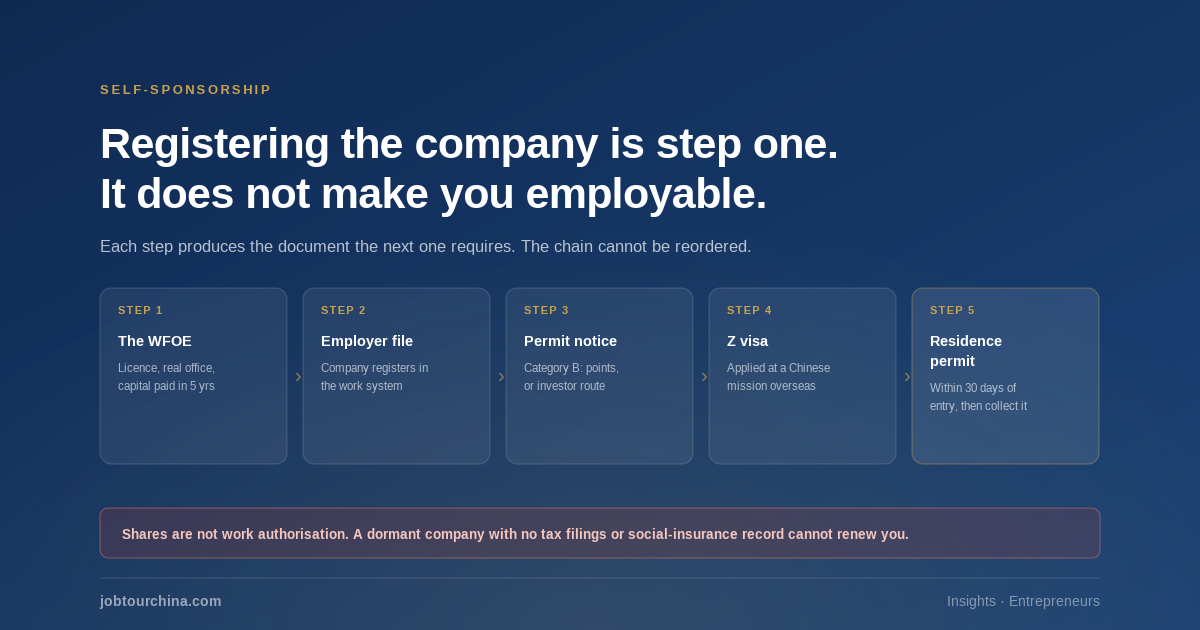
Yes — but not by registering the company. The company has to exist first, and then it sponsors you. That order is the whole answer, and it is the part most founders get backwards: they assume that owning a Chinese company confers the right to run it. It does not. Shareholding and a business licence are not work authorisation. Until you hold a work permit and a work-type residence permit, managing or operating that company in China is illegal employment, even though the company is yours.
What follows is the sequence as it actually runs in Guangzhou, which is one of the more permissive cities for foreign founders and therefore a useful baseline. Other cities follow the same logic with different thresholds.
The five steps, in order
- Incorporate the WFOE and obtain the business licence.
- Register the new company as an employer in the Foreigners Working in China service system.
- File the work permit application for yourself as legal representative; receive the permit notice.
- Apply for the Z visa at a Chinese embassy or consulate abroad, using the notice.
- Enter, register your address within 24 hours, then convert to a work-type residence permit within 30 days and collect the permit card.
Steps 1 to 3 are the ones that trip people up, because they involve two different regulators and neither will proceed on a promise.
Step 1: the entity itself
You need a company name, a business scope, registered capital, and a real address. Overseas documents — passport, police-clearance certificate, and any corporate documents if a foreign company is a shareholder — need notarisation plus an apostille (for Hague Convention members) or consular legalisation (for everyone else), with a certified Chinese translation.
Two things have tightened. First, virtual addresses are now scrutinised: districts increasingly verify that the premises exist and that a business can plausibly operate there, and a registered address with no physical office is a common rejection reason. Second, since the revised Company Law took effect in July 2024, subscribed capital must be paid in within five years of incorporation. The old "subscribe something enormous, pay nothing" structure is gone, and the capital figure you write down is now a commitment with a deadline.
After the licence you still need the company chop, tax registration and foreign-exchange filing before the entity is operational. The work-permit file will reference this stage, so keep the paperwork.
Step 2: the company registers as an employer
This is the step founders skip. A newly incorporated company cannot sponsor anyone until it is registered in the work-permit system as a qualifying employer. That registration asks for the licence, the legal representative's details and the company's basic particulars — and it is the reason the permit application cannot be filed before incorporation completes.
Step 3: your own permit application
As legal representative you will normally apply as Category B professional talent. There are two ways in: the points table, which scores your degree, years of relevant experience, salary and age, or a local investor-entrepreneur route that looks at paid-in capital, shareholding and evidence of actual business involvement. Guangzhou operates such a policy for foreign investors; the thresholds are set locally and are revised, so confirm the current figures with the district science and technology bureau before you build a plan around them.
The file itself is unremarkable and unforgiving: application form, business licence, appointment letter, passport, authenticated police-clearance certificate, medical examination, and the degree or qualification documents. The appointment letter matters more than founders expect — it should state your duties and your salary, and the salary must be at or above Guangzhou's statutory minimum wage and consistent with the position. A legal-representative appointment letter that says nothing about what you actually do is a weak file.
Step 4 and 5: the visa, then the residence permit
With the permit notice in hand you apply for a Z visa abroad. There is no domestic shortcut here; the Z visa is issued by a Chinese mission outside the country. On arrival, register your address within 24 hours, then within 30 days of entry apply for the work-type residence permit and collect the work permit card. Missing the 30-day window turns a straightforward conversion into an overstay problem.
Why shell companies fail now
The single most common misconception is that incorporation plus a business licence is enough to stay and operate. It is not, and the enforcement pattern has shifted from documents to substance. Applications are refused, or refused at renewal, when:
- the registered address cannot be verified or has no actual office;
- the company has no tax filings — even nil returns — for the periods it claims to be operating;
- no social insurance has been paid for any employee, including the legal representative;
- the business scope on the licence does not match the activities described in the appointment letter;
- the stated salary sits below the local minimum wage, or is implausible for the role.
At renewal the authorities review operating status, tax records and social-insurance contributions together. A company that has been dormant for a year is not a sponsor, whatever its licence says.
After approval: the maintenance nobody plans for
Track both expiry dates — work permit and residence permit — and start renewal 45 days out so the statutory 30-day filing window has slack. Any change of legal representative, shareholder or registered address has to be reflected in the work permit, and the amendment is filed by the company within 10 working days of the change. Founders who restructure their cap table and forget the permit discover the gap at the airport.
When a WFOE is the wrong instrument
If the real objective is to stay in China rather than to run a business, incorporating is an expensive way to solve it and an increasingly ineffective one. There are legitimate employer-free routes — family reunion, study, the K visa introduced in October 2025 for young STEM talent, and others — covered in staying in China without an employer. A company that exists only to hold your residence permit is exactly the pattern that gets refused.
If you do intend to trade, the structure is sound, and the sequence above is the cheapest path through it. Budget for the fact that steps 1 to 3 involve two regulators, an authentication chain that starts in your home country, and a physical address — and that none of these can be compressed by paying more.
This article is general guidance based on the rules in force at the date above, not legal or immigration advice. Requirements and local practice change; confirm your own case with the competent authority or a qualified professional.
Related reading: Staying without an employer · Work permit categories · First 30 days · Guangzhou guide · All insights.
Sources
- Exit and Entry Administration Law of the People's Republic of China — National Immigration Administration, official English text. Article 41: a company registration is not a work authorisation.
Official text, checked 18 November 2026. Quoted for reference only; the Chinese original prevails.