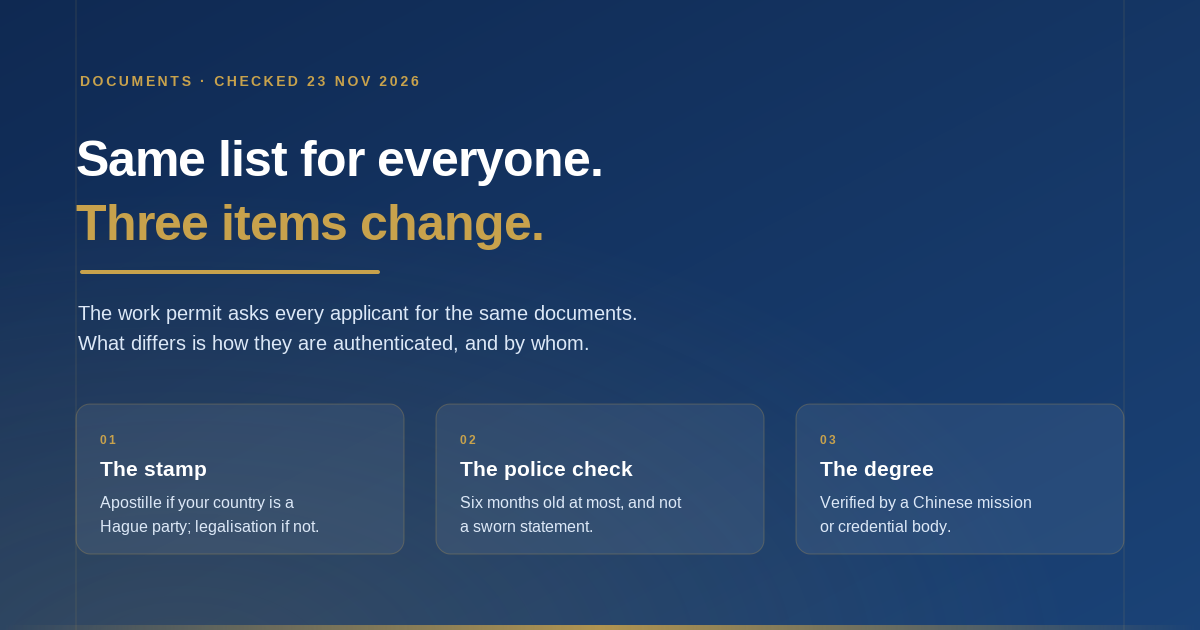
Every applicant for a Chinese work permit submits the same list of documents. What changes is the authentication attached to three of them — and one detail almost nobody checks before signing a contract: whether your country has a social-security agreement with China.
The rules below come from the official work-permit service guides published by Chinese districts, the Hague Conference status table, and the Ministry of Human Resources and Social Security. All were checked on 23 November 2026.
The list, and which items move
The standard application asks for nine items. Six of them are the same whoever you are. Three depend on where the document was issued, and one more depends on your nationality rather than on any document at all.
| Item | What changes with your country |
|---|---|
| Application form | Nothing. Filled online, printed, signed, stamped by the employer. |
| Work experience certificate | Nothing structural. Non-Chinese documents need a translation stamped by the employer. |
| Highest degree | The verification route, by where the degree was awarded. See below. |
| Criminal record check | The issuer, the validity window and whether an apostille replaces consular legalisation. |
| Medical certificate | Whether yours was issued by a Chinese inspection body or by a clinic it recognises abroad. |
| Employment contract | Nothing. Must be in Chinese, signed by you and stamped by the employer. |
| Passport | Nothing. At least six months of validity left. |
| Photograph | Nothing. Taken within six months, full face, no covering. |
| Social insurance | Whether a bilateral agreement lets you stay in your home scheme instead. |
1. The stamp: apostille or consular legalisation
China deposited its accession to the Hague Apostille Convention on 8 March 2023, and it entered into force for China on 7 November 2023. The practical effect is straightforward: a public document issued in another contracting party needs a single apostille, and no longer needs to go through a Chinese embassy or consulate.
For a country outside the Convention, nothing changed. The document still goes to the foreign ministry, then to the Chinese embassy or consulate there, and that chain takes weeks rather than days.
Two practical notes. First, the apostille certifies the signature and seal, not the content; a translated document still needs a proper translation, and some localities want the translation itself certified. Second, not every accession is in force yet — an accession date is not an entry-into-force date, and recent accessions are worth confirming with the employer's local science and technology bureau before you pay for anything.
2. The criminal record check
This is the item that fails most often, and the failures are avoidable. The official wording requires a check issued by the police, security or court authority of your country of nationality or of your country of habitual residence, authenticated, and issued within the last six months.
- Habitual residence means the country where you last lived continuously for a year or more, excluding China. If you have been working in a third country for years, a check from that country is the one that counts.
- Six months runs from the issue date on the certificate, not from the date you submit it. A check obtained in January is unusable for an August start.
- A sworn statement by you that you have no convictions is explicitly not accepted. It has to come from an authority.
- Category A applicants are exempt: for them this item runs on an undertaking instead of a certificate, and so does the degree.
- A non-sworn certificate issued by a diplomatic mission is accepted directly, without further authentication.
3. The degree
The route depends entirely on where the degree was awarded, and the three cases are treated differently.
- Awarded abroad: authenticated by a Chinese embassy or consulate, or by the embassy in China of the country that awarded it, or by a Chinese credential verification body.
- Awarded in Hong Kong, Macao or Taiwan: verified by a Chinese credential body, or notarised by a notary in that region.
- Awarded in mainland China: the original certificate is enough. No authentication.
Professional qualifications follow a similar logic but stricter: a foreign professional licence has to be authenticated by a Chinese mission, or notarised at the issuing end. For regulated professions this is where the timeline really sits, because the licence and its authentication have to arrive before the permit application can be filed.
4. The medical certificate
Six months, same as the police check. It can come from a Chinese inspection and quarantine body, or from an overseas clinic that body recognises, and the list of recognised clinics is published through Chinese missions. Applicants already inside China on a valid residence permit are exempt.
There is a sequencing trick here that saves weeks: the medical can be done on an undertaking before entry, and completed at a Chinese inspection body after arrival, when the residence permit is issued. Ask the employer which order their local bureau accepts.
5. The social-security agreement nobody checks
This one is not a document in your application, so it never appears on a checklist — but it changes your net pay. China has signed bilateral social-security agreements with thirteen countries. Eleven are in force: Germany, Korea, Denmark, Finland, Canada, Switzerland, the Netherlands, Spain, Luxembourg, Japan and Serbia.
France and Kyrgyzstan have signed but the agreements are not yet in force. Austria signed on 6 November 2026 and is not in force either. Everyone else has no agreement at all.
What an agreement does is narrow but valuable: if you are seconded or employed in China and your home scheme keeps covering you, a certificate of coverage issued by your home authority exempts you from the corresponding Chinese contributions — pension and, depending on the treaty, unemployment — for the agreed period. It is not a tax treaty, and it does not touch income tax.
What this means in your region
The six blocks below cover the countries most of our readers apply from. They are not exhaustive; the rule is the Convention membership, not the region, and the table at the Hague Conference is the authority.
Applying from France, Belgium, Switzerland or Canada
All four are Apostille parties, so your police check and degree need an apostille, not consular legalisation. Switzerland and Canada have social-security agreements in force; France has signed one but it is not in force, so do not plan around an exemption yet. Belgium has no agreement. The same applies to Morocco, Tunisia and Algeria, which are also Apostille parties, and Algeria, whose accession took effect on 9 July 2026.
Applying from Spain or Latin America
Spain, Mexico, Argentina, Colombia, Chile, Peru and Ecuador are all Apostille parties. Only Spain has a social-security agreement in force with China; for the Latin American states there is none, so expect the full Chinese contributions.
Applying from Russia, Kazakhstan or Central Asia
Russia, Kazakhstan, Kyrgyzstan, Ukraine, Belarus and Uzbekistan are all Apostille parties. None of them has a social-security agreement in force, although Kyrgyzstan has signed one. If you have been working in a third country for more than a year, your police check should come from there rather than from your passport country.
Applying from Vietnam
Vietnam deposited its accession on 31 December 2025 and the Convention entered into force for Vietnam on 11 September 2026. That is a real change: documents that previously needed the full consular chain now need a single apostille. There is no social-security agreement, so the Chinese contributions apply in full.
Applying from South Asia, Southeast Asia or Africa
India, Pakistan, Bangladesh, the Philippines, Indonesia, Singapore and South Africa are Apostille parties, so one apostille is enough. Malaysia, Sri Lanka, Nepal, Cambodia, Laos, Myanmar, Nigeria, Kenya and Ethiopia are not, and their documents still go through the full foreign-ministry and Chinese-consulate chain.
Thailand is the case to watch. It deposited its accession on 30 June 2026, but the Convention only enters into force for Thailand on 28 February 2027. Until that date a Thai police check or degree still needs consular legalisation, and an apostille obtained early will be refused. None of the countries in this group has a social-security agreement with China, so the Chinese contributions apply in full.
Applying from the Gulf, Egypt or the Levant
This is the region where the split matters most. Saudi Arabia, Bahrain, Oman, Morocco, Tunisia and Algeria are Apostille parties. Egypt, the United Arab Emirates, Qatar, Kuwait, Jordan, Lebanon and Iraq are not, so documents from those countries still go through foreign ministry legalisation and then a Chinese embassy or consulate. Budget several weeks, and start with the police check because it is the slowest item. No country in the region has a social-security agreement with China.
If your country does not appear in any of these blocks, that changes nothing about the rule: look it up in the Hague Conference status table, and check the entry-into-force date rather than the accession date. For the social-security list there is nothing to look up — it runs to thirteen signed agreements and eleven in force, and every other nationality pays the Chinese contributions in full.
Common mistakes
- Ordering the police check too early. It expires in six months, and the permit process routinely takes longer than the planning assumes.
- Getting a check from the wrong country. It must be the country of nationality or of habitual residence, and habitual residence means a year or more, not a holiday address.
- Sending a sworn declaration. It is refused, and the refusal arrives weeks after submission.
- Getting the apostille in the wrong country. An apostille can only be issued by the state whose document it is, so a degree awarded in one country cannot be apostilled in another, whatever your residence permit there says.
- Assuming your accession date is your entry-into-force date. For recent parties these differ by months, and an apostille obtained too early can be rejected.
- Budgeting for a social-security exemption you do not have. If your country is not on the list of eleven, the contribution is deducted from your salary.
- Forgetting that everything non-Chinese needs a translation, and that some bureaus want the translation stamped by the employer.
What to do next
- Check your country in the Hague Conference status table, and note whether the entry into force has happened.
- Order the criminal record check first. Everything else in the file is faster.
- Check whether your country is on the list of eleven social-security agreements before you accept a salary figure.
- Ask the employer's local bureau two questions: which authentication they accept for the police check, and whether the medical can be completed after arrival.
- Read the two pages below before you send anything: the full document list, and what happens after you accept.
Read next
This article is general guidance based on the rules in force at the date above, not legal or immigration advice. Requirements and local practice change; confirm your own case with the competent authority or a qualified professional.
Sources
- HCCH — Apostille Convention, status table — contracting parties and their accession and entry-into-force dates; China 8 March 2023 and 7 November 2023, Viet Nam 31 December 2025 and 11 September 2026.
- Nanhai District (Foshan) — foreigner work permit service guide — the nine application items, the six-month validity of the police and medical certificates, the habitual-residence definition, the rejection of sworn statements and the Category A undertakings.
- Pingyi County — foreigner work permit (Category C) service guide — the same requirements restated for a Category C application, including the three degree verification routes.
- Invest Shanghai — guide to applying inside China — police check and degree authentication wording, and the exemption from the medical certificate for holders of a valid residence permit.
- MOHRSS — notice on implementing bilateral social-security agreements (2025 No. 27) — the eleven agreements in force, and the statement that France and Kyrgyzstan have signed but not yet brought theirs into force.
- MOHRSS — questions and answers on the China-Austria social-security agreement — the list of thirteen signed agreements, the exemption mechanism, and the signing with Austria on 6 November 2026.
Official pages, checked 23 November 2026. Requirements change without notice; the linked page prevails over this summary.
Related reading: Work visa overview · Salary & tax · All insights.